Feeds:
Posts
Comments

Archive for the ‘Bible’ Category

This series of posts (When Negative Thoughts Persist) looks at the scripture in 2 Corinthians 10:4 “the weapons of our warfare are not carnal but mighty in God for pulling down strongholds, casting down arguments and every high thing that exalts itself against the knowledge of God, bringing every thought into captivity to the obedience of Christ.”   From 2 Corinthians, we then proceeded to Ephesians 6 to review the weapons which are described by Paul there.

All this that we might effectively battle persistent negative thoughts.  As followers of God, we need to forgive those who wrong us.  However, even after we have forgiven someone, we may experience occasional or even recurring thoughts reminding of what the wrong, how it hurt, how unfair it was or the like.

 The mind is a battlefield, in this post, we will consider a few more of the weapons we have available to us:
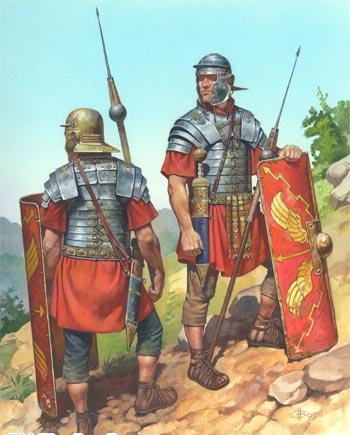
  • The Breastplate of Righteousness –  having put on the breastplate of righteousness  The breastplate is a defensive weapon that protects our vital organs, those essential to life. The breastplate protects the warrior from attack aimed at the heart, lungs or other nearby organs.   We must allow Christ, His righteousness to protect us.  We are not righteous in ourselves, because no work of the flesh could ever save us or make us righteous; however, we are righteous as we stand in Christ, who provided the required sacrifice and who is our substitute, our righteousness by faith.
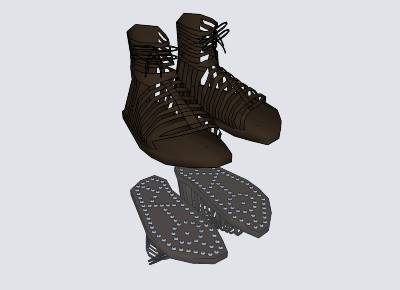
  • The Gospel of Truthhaving shod your feet with the preparation of the gospel of peace   Know the Word of God.  Let it give you sure footing in battle allowing you to stay standing until the end.  When plagued with negative thoughts, review, recite, and/or meditate on a scripture promise or truth that counters the lie that the enemy would tell you.
Read Full Post »

In our last post, we began our discussion of how to deal with persistent negative thoughts.  If we are obedient to the command of God, we know that we need to forgive those who wrong us.  However, even when we have forgiven someone, we may experience occasional or even reoccurring thoughts reminding of what they did to us, how it hurt, how unfair it was or the like.
The mind is a battlefield, but we have weapons which are mighty in God according to 2 Corinthians, which we discussed in the last post.
In this post, I want to take a closer look at some of the weapons to see how they can help us in the battle with recurring or persistent negative thoughts (sometimes known as Stinkin’ Thinkin’)
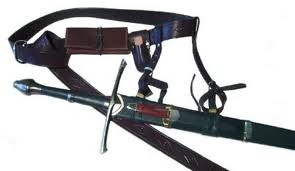
  • The Whole Armor of God – Therefore take up the whole armor of God, that you may be able to withstand in the evil day, and having done all, to stand.  No one weapon will protect a solider in battle from injury.  That is why Paul exhorts us to put on the whole armor of God.  Leaving one piece of the armor off can expose the soldier to great injury and render him or her ineffective in battle.   Leave no weapon behind.
  • The Belt of Truth –Stand therefore, having girded your waist with truth  Let truth be like a belt to keep your movement uninhibited and allow you to move quickly and easily in battle.  The belt can seem like a frivolous accessory until you get caught with your pants down.  Living in the truth and having truth as our belt keeps us from being susceptible to the devil who hates truth and is called “the father of lies.”  It may be hard to always tell the truth.  Even some of the Fathers of the Faith, like Abraham were caught in lies, but they always paid a price for the lies.  Whenever we fail to put on the belt of truth, we make it harder for us to be successful in battle for the important things.

Read Full Post »

I beseech you therefore, brethren, by the mercies of God, that you present your bodies a living sacrifice, holy, acceptable to God, which is your reasonable service. Romans 12:1

My reasonable service?  Why would presenting my body a living sacrifice be my reasonable service to God?

The answer lies in my status:  I am a bond servant.

  • I was bought with a price.  I belong to someone.  He redeemed me from my bondage.
  • I chose to stay even after I was set free.  By my solemn vow, I have promised to obey and serve my Master forever.
  • It is reasonable for a servant to serve her master.  That is what servants do.
  • It is reasonable to do what one is created to do.

The great irony is that even though I was only a bond servant, the Master calls me His daughter, and He has given me an inheritance, something only a child receives.  Indeed, I have been made a child of God.  I call Him Abba  (translated:  “Papa”)

The miracle of grace is that while all He expects from me is my reasonable service, He has made me a co-heir with Christ.

Read Full Post »

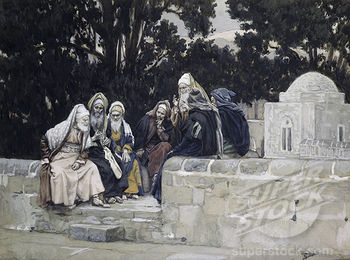
Matthew recounts the story in Matthew 22:17-21 where Jesus is speaking with the Pharisees and the Herodians.  They are trying to trick Him, but He is still calling them to the Father despite their contempt for him.  The following is the short exchange:

“Tell us, therefore, what do You think? Is it lawful to pay taxes to Caesar, or not?”

But Jesus perceived their wickedness, and said, “Why do you test Me, you hypocrites? Show Me the tax money.” So they brought Him a denarius.  And He said to them, “Whose image and inscription is this?”

They said to Him, “Caesar’s.”

And He said to them, “Render therefore to Caesar the things that are Caesar’s, and to God the things that are God’s.”

“God created man in His own image; in the image of God He created him.”  Genesis 1:27   It is the image of God that each man and each woman bears not unlike the coin bearing the image of Caesar.

And as with the coin, which must be returned to the one whose image it bears, so the man or woman, who bears the image of God, must be returned to God.  This is the heart of God, to draw back to Himself all those bearing His image.

It is not enough to admire the LORD, we need to render our lives to Him.

Render unto God what is God’s.

Read Full Post »

Ever have someone wrong you, and you forgave them but negative thoughts persist?    I have found myself with such thoughts more than once.  So what’s a body to do?

Choosing the right weapons

For though we walk in the flesh, we do not war according to the flesh.  For the weapons of our warfare are not carnal but mighty in God for pulling down strongholds, casting down arguments and every high thing that exalts itself against the knowledge of God, bringing every thought into captivity to the obedience of Christ  2 Corinthians 10:3-5

The battle will wage regardless of the weapons we choose to take up to fight.  Although no one can escape the  battle, the good news is two-fold:

  • The battle is won.  Jesus said, “It is finished.”
  • The weapons are “in God.”  This means that I do not have to think about finding my own weapons or using ineffective weaponry to fight my foes.

What are the weapons that I can use?

  • The Whole Armor of God
  • The Belt of Truth 
  • The Breastplate of Righteousness 
  • The Gospel of Truth
  • The Shield of Faith
  • The Helmet of Salvation
  • The Sword of the Spirit
  • Prayer                                                          –Ephesians 6:13-18

These weapons will help us to bring those thoughts, those persistent thoughts, into captivity to the obedience of Christ.  We will look in more detail at what this means and how this might be applied to our lives more specifically in the next post.

Read Full Post »

In preparation for Easter, consider what those who know acknowledge the God who hung on the cross and rose from the dead are celebrating:

Sacrificial death – re-established relationship with God (God’s righteous standard was satisfied)

  • Hebrews 9:27 And as it is appointed for men to die once, but after this the judgment.
  • Leviticus 17:11 The life of the flesh is in the blood, and I have given it to you upon the altar to make atonement for your souls; for it is the blood that makes atonement for the soul.
  • 2 Corinthians 5:21 For He made Him who knew no sin to be sin for us, that we might become the righteousness of God in Him.
  • Ephesians 2:13 But now in Christ Jesus you who once were far off have been brought near by the blood of Christ.

Payment for Sin

  • Isaiah 53:12 He poured out His soul unto death, And He was numbered with the transgressors, And He bore the sin of many, And made intercession for the transgressors.

Victory over Death

  • Romans 6:23 For the wages of sin is death, but the gift of God is eternal life in Christ Jesus our Lord.
  • 1 Peter 1:3-4 Blessed be the God and Father of our Lord Jesus Christ, who according to His abundant mercy has begotten us again to a living hope through the resurrection of Jesus Christ from the dead,4 to an inheritance incorruptible and undefiled and that does not fade away, reserved in heaven for you,

The Righteousness and Justice of God towards Men

  • Romans 3:21-26 But now the righteousness of God apart from the law is revealed, being witnessed by the Law and the Prophets, 22 even the righteousness of God, through faith in Jesus Christ, to all and on all who believe. For there is no difference; 23 for all have sinned and fall short of the glory of God, 24 being justified freely by His grace through the redemption that is in Christ Jesus, 25 whom God set forth as a propitiation by His blood, through faith, to demonstrate His righteousness

Read Full Post »

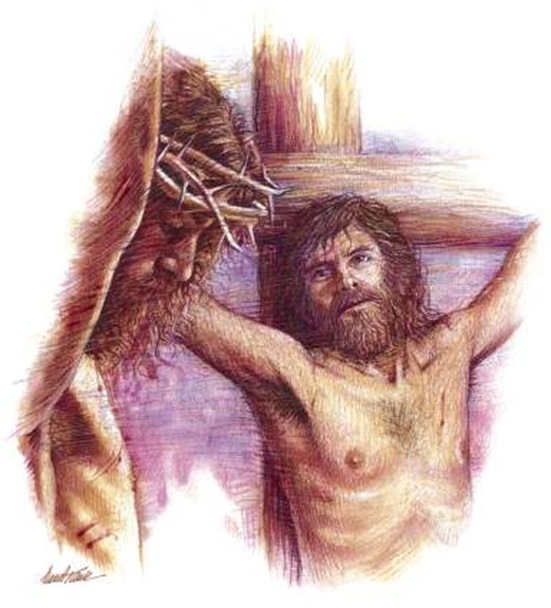
Luke 23 recounts the story of Jesus hung on the cross between the two criminals, one on his right and the other on his left.

Then one of the criminals who was hanged blasphemed Him, saying, “If You are the Christ, save Yourself and us.”

But the other, answering, rebuked him, saying, “Do you not even fear God, seeing you are under the same condemnation?  And we indeed justly, for we receive the due reward of our deeds; but this Man has done nothing wrong.”

Then he said to Jesus, “Lord, remember me when You come into Your kingdom.”

And Jesus said to him, “Assuredly, I say to you, today you will be with Me in Paradise.”  Luke 23:39-43

The thief’s relationship with God changed while he hung on the cross.  The thief hanging on the other side never changed his position.  We can only assume he will spend eternity separated from God in unspeakable torment and darkness.

One of the first fruits of Jesus’ crucifixion was the salvation of the one thief, a clear picture of God’s heart for the lost.  He is never too busy with His “agenda” to save one lost soul.  Even as He went to lay down His life to save all of humanity, He took time to save one wretched criminal even as his life was ebbing away.

Hallelujah!  What a Savior!

Read Full Post »

Easter can surely be seen in Numbers, the 4th of the 5 books of the Pentateuch as the books of the law are often called.

Serpent on a pole

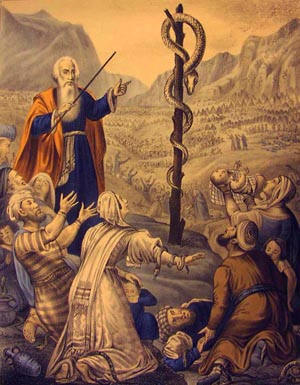
In Numbers 21, when the people had spoken against Moses and God, God sent fiery serpents among the people.  The serpents bit the people and many died.  When the Moses prayed for the LORD to have mercy on the people, God told Moses to make “a fiery serpent and put it on a pole; and it shall be that everyone who is bitten, when he looks at it, shall live.”   It was just as God had said.  God provided an antidote to save those who were otherwise doomed.

We know that this story speaks of the Son of Man because Jesus tells Nicodemus in John 3 “as Moses lifted up the serpent in the wilderness, even so must the Son of Man be lifted up, that whoever believes in Him should not perish but have eternal life.  For God so loved the world that He gave His only Son, that whoever believes in Him should not perish but have everlasting life.”   This time God was offering up His own son on a pole to save the lives of those who would believe.

The idea of a serpent on the pole being able to heal those who look on it seems too simple.  It is the same with the cross.  How simple is it?  Jesus said that whoever believes in the Son of Man, will have eternal life.  The cross was the way to get the attention of the lost and dying.  “Look up here!”  He said.  “You can be saved!”

Jesus foretold his own death by crucifixion.  In John 12, it is recorded that Jesus said, “If I am lifted up from the earth, [I] will draw all peoples to Myself.” It goes on to say in the verse following, just so no doubt is left in the reader’s mind, “This He said, signifying by what death He would die.” 

Easter in Numbers.

Read Full Post »

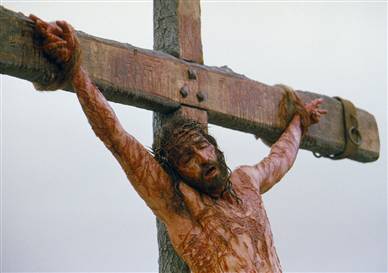
Why did Jesus need to be hung on a wooden cross?

Crucifixion was a Roman convention, not something provided for by Jewish law.  As a matter of fact, the Bible teaches “cursed is anyone who hangs on a tree.”  Deut. 21:23.  So why would the Jewish Messiah, the anointed one of God, be crucified on a wooden cross?

  • To Fulfill Prophecy – The Psalmist speaks of crucifixion in Psalm 22, a psalm which clearly speaks of Jesus, “for dogs have surrounded Me; The congregation of the wicked has enclosed Me. They pierced My hands and My feet.” Other scriptures in Psalm 34:20, Zechariah 12:10, and Isaiah 53 all foretell of the trial and crucifixion of Jesus.
  • To Illustrate the Suffering that Sin Brings – Jesus suffered on the cross.  We know this because in Matthew and Mark’s gospels, they record Jesus’ last words as “My God, My God, why have You forsaken Me?”  These words speak of great torment and suffering, of the soul searching in vain for God.  And so it will be with the sinner who fails to appropriate the blood shed at Calvary to his or her own sin.  If you fail to accept the sacrifice of Jesus as sufficient and apply it to your life through repentance and confession of Him as Lord and Savior, you have an ongoing sin problem.  How will you, in your sin, approach a Holy God?  No promise of heaven is given to those not covered by the blood of Jesus, only a promise of eternal separation from God.  Eternal life is a certainty.  The only uncertainty is where it will be spent.
  • Because Blood Alone Makes Atonement for the Soul – The most important reason for the crucifixion was the shedding of the blood.  According to Leviticus 17:11, “the life of the flesh is in the blood, and I have given it to you upon the altar to make atonement for your souls; for it is the blood that makes atonement for the soul.” Walk with me down the Romans road:  “All have sinned and fall short of the glory of God.” Rom. 3:23 “There is none righteous, no, not one.”  Rom. 3:10  “The wages of sin is death.” Rom. 6:23   Add to that the statement from Leviticus, “the blood . . . makes atonement for the soul.” There is only one conclusion to be reached;  there had to be a sacrifice, a blood sacrifice.  Someone had to die that I might live . . . that you might live.  Who would be the sacrificial offering (the propitiation) for my sin?  for your sin?  Who could meet the perfection standard outlined in God’s law?  Who would be without blemish, without sin?  Whose blood would be able to wash me . . . to wash you white as snow?  Only Jesus!  Crucifixion was necessary because our sin separated us from God, and God desired to be in fellowship with us.   God so loved the world . . .  God so loved me . . . God so loved you . . . blood had to be shed.  Unless you lived a sinless life and met the law of God in every point, you also need Jesus to have died on the cross, to have shed His precious blood.  Jesus was crucified, suffered, and bled because of me . . . because of you.

In this is love, not that we loved God, but that He loved us and sent His Son to be the propitiation for our sins.  1 John 4:10

Read Full Post »

Ever wonder why the image of the cross figures so predominantly in the New Testament.  It’s more than the obvious – Jesus died on a cross.

Mark 5:34 records Jesus speaking, “Whoever desires to come after me, let him deny himself and take up his cross and follow me.”  When Jesus made this statement, he hadn’t gone to the cross yet.

John Stott says “becoming a Christian involves a change so radical that no imagery can do it justice except death and resurrection – dying to the old life of self-centeredness and rising to new life of holiness and love.”

In Galatians 5:24, Paul writes “those who are Christ’s have crucified the flesh of its passions and desires.”

In Romans 6:6, he says,  “our old man was crucified with Him.”  He repeats the imagery of the cross and death on the cross to speak of living a life of self-denial – death to self.

Often people think that their “cross” is the trial or persecution they are undergoing.  The trials are not the cross.  The trials function to strengthen one to carry his or her cross.  The cross is the life of self-denial, the laying down of one’s own life for the furtherance of the gospel.

As a Christian, I am best described as “dead man walking” since I must carry the instrument of my own execution, the cross.  I must die, so He might live through me.  By this great miracle, others will see Him and His glory and be drawn to Him.  Thus, the gospel is spread.

Father, make me to be dead to self and alive to Your Spirit.  May Easter remind me of how that fully-surrendered life appears.

Read Full Post »

« Newer Posts - Older Posts »