Feeds:
Posts
Comments

Archive for the ‘Bible’ Category

Why did Jesus have to be betrayed by one of those closest to him as well as those in religious authority?

1.  It was the fulfillment of scripture.

  • Psalm 41:9 “Even my own familiar friend in whom I trusted, Who ate my bread, Has lifted up his heel against me.”  See also John 13:18 confirming fulfillment of the prophecy.

2.  It was necessary so we could know that God understands and can sympathize with our situations, the betrayals we suffer at the hands of those closest to us and those in authority over us.

  • Hebrews 4:15 “For we do not have a High Priest who cannot sympathize with our weaknesses, but was in all points tempted as we are, yet without sin.”

We have all been betrayed.  Our inclination is to seek revenge or punishment for our betrayer.  But Jesus was betrayed, and He did not defend Himself.  Rather, He lived out the sovereign will of His Father, trusting that the Father would change the circumstances if He willed.  Jesus understood that the will of the Father (God), is the primary focus for the Son (and for us as children of God).

3.  It is clear evidence of the “religious’ heart of man apart from God.

The betrayal of Jesus by his own people, by the “religious” of his day, is a warning to us of what can happen when we allow our religion to become more important than our faith in and relationship with the Savior.  Jesus warned the religious leaders, but they were unmoved.  They had no heart for God.

Jesus was betrayed because that is our relationship with God apart from Christ.  We are betrayers.  We can’t keep the law.   We can’t put the will of the Father before our own desires.  He had to show us how.  He had to make a way for us.  Betrayal was the first part.

Read Full Post »

The need for Easter began with man’s expulsion from the garden, but Genesis (and much of the history of Israel as it is documented in the Old Testament) chronicles the depravity of man and the righteous judgments of God.

These stories are warnings to the heart of man which says, ” God is dead” or ” God forgets” or “God doesn’t care” or “God is only love”.  The truth of the heart of God is that He does care, He is righteous and holy, and He wants none to perish, but some will perish.  The ungodly shall not stand in the judgment, nor sinners in the congregation of the righteous. For the LORD knows the way of the righteous, but the way of the ungodly shall perish.  Psalm 1:5-6.

Consider evidences of the judgment of God in Genesis alone:

  • The flood
  • Tower of Babel
  • Sodom & Gomorrah

Just as He has judged the wickedness of man before, so He will judge again.  In the final judgment, only those who are covered in the blood of Jesus will stand.

Easter is about the blood of Jesus poured out for a lost and dying world.

Does the blood of Jesus cover you?  If not, how will you stand in the judgment?   It is appointed for men to die once, but after this the judgment.  Hebrews 9:27

Read Full Post »

Easter in Genesis?

It is no mystery to the student of scripture that every book of the Bible has a little Easter running through it.  Easter is all about love, God’s love.

The heart of Easter pre-dates creation.  Before man was in need of a Savior, the God who loves enough to give us Easter was.

The need for Easter, however, can be found squarely in Genesis.  When man violated the one rule God had given him, man’s perfect fellowship with God was broken.  Easter represents man’s only hope, his one way back into that fellowship with God.

God is holy.  He alone is holy.  Sinful man* cannot approach or have close relationship with a holy God without dealing with his or her sin problem.  Sin is an abomination to God.

Just as darkness and light cannot co-exist in the physical realm, so holiness and sin cannot co-exist in the spiritual realm.

The promise of Easter is found in Genesis 3:15.  And I will put enmity Between you and the woman, And between your seed and her Seed; He shall bruise your head, And you shall bruise His heel.”

*For whoever shall keep the whole law, and yet stumble in one point, he is guilty of all.  James 2:10

Read Full Post »

Here are the questions and answers to the Easter I.Q. Test:

1.  What Jewish holiday was Jesus celebrating right before his trial and subsequent crucifixion?  PASSOVER

2.  What event did the Prophet Zechariah foretell in his statement “Rejoice greatly, O daughter of Zion!  Shout, O daughter of Jerusalem!  Behold, your King is lowly and riding on a donkey, a colt, the foal of a donkey.”  (Zechariah 9:9)  JESUS’ TRIUMPHAL ENTRY INTO JERUSALEM

3.  What Easter-related event is predicted to the day in Daniel 9?  MESSIAH’S RIDING INTO JERUSALEM ON A DONKEY (REPRESENTING HIMSELF AS A KING OF PEACE)

4.  Where was Jesus taken first after his arrest? HOUSE OF ANNAS

5.  Upon whose testimony was Jesus sentenced to death?  HIS OWN.  THEY COULD NOT FIND TWO WITNESSES WHO AGREED AND JESUS FINALLY ANSWERED THE QUESTION, “ARE YOU THE CHRIST, THE SON OF GOD?” “IT IS AS YOU SAY.”

6.  To what representative of the Roman government was Jesus taken for permission to carry out the death sentence?  PONTIUS PILATE, ROMAN GOVERNOR

7.  What prisoner was released instead of Jesus at the request of the crowd?  What crimes was he accused of?  BARABAS, REBELLION, ROBBERY, MURDER

8.  How many men were crucified with Jesus?  THREE

9.  Who are two of the people (there were more than 2) at the cross when Jesus died? JOHN, MARY, THE MOTHER OF JESUS; MARY’S SISTER; MARY THE WIFE OF CLOPAS; AND MARY MAGDALENE.

10.  What is in the tomb where Jesus was laid after he died on the cross?  NOTHING.  THE TOMB IS EMPTY!  HALLELUJAH!  HE IS RISEN!

Read Full Post »

Answer the following basic questions about Easter and find out your Easter I.Q. :

1.  What Jewish holiday was Jesus celebrating right before his trial and subsequent crucifixion?

2.  What event did the Prophet Zechariah foretell in his statement “Rejoice greatly, O daughter of Zion!  Shout, O daughter of Jerusalem!  Behold, your King is lowly and riding on a donkey, a colt, the foal of a donkey.”  (Zechariah 9:9)

3.  What Easter-related event is predicted to the day in Daniel 9?

4.  Where was Jesus taken first after his arrest?

5.  Upon whose testimony was Jesus sentenced to death?

6.  To what representative of the Roman government was Jesus taken for permission to carry out the death sentence?

7.  What prisoner was released instead of Jesus at the request of the crowd?  What crimes was he accused of?

8.  How many men were crucified with Jesus?

9.  Who are two of the people (there were more than 2) at the cross when Jesus died?

10.  What is in the tomb where Jesus was laid after he died on the cross?

Be sure to write your answers down.  The key to the quiz will be in an upcoming  post.

Read Full Post »

I beseech you therefore, brethren, by the mercies of God, that you present your bodies a living sacrifice, holy, acceptable to God, which is your reasonable service.  Romans 12:1

Acceptable to God?  What does it mean to be acceptable to God?

The apostle Paul says “for the kingdom of God is not eating and drinking, but righteousness and peace and joy in the Holy Spirit. For he who serves Christ in these things is acceptable to God and approved by men.  Romans 14:17-18.

The “these things” appears to refer to verse 17, “righteousness and peace and joy in the Holy Spirit.”  When we serve Christ in righteousness, peace and joy in the Holy Spirit, this is acceptable to God.

What does righteousness require?  Those who are righteous are in right standing before God.  They meet or match God’s standard of holiness and right conduct.

One doesn’t have to be a Bible scholar to know that no one can meet God’s standard.  The Bible teaches that there is none righteous.  Romans 3:10.   According to God, “all our righteousnesses are like filthy rags.”  Isaiah 64:6

Therefore, since my own righteousness is insufficient, I must seek the righteousness of Christ.   When God looks at me, I want Him to see Christ’s righteousness, not my own.   How can this be accomplished?

Paul tells us in Romans:  For when we were still without strength, in due time Christ died for the ungodly. For scarcely for a righteous man will one die; yet perhaps for a good man someone would even dare to die.  But God demonstrates His own love toward us, in that while we were still sinners, Christ died for us.  Much more then, having now been justified by His blood, we shall be saved from wrath through Him.  For if when we were enemies we were reconciled to God through the death of His Son, much more, having been reconciled, we shall be saved by His life.  Romans 5:6-10.

So it is the blood . . . there is power in the blood . . . covered in the blood of the perfect sacrifice (Jesus), I can be seen by God as having the righteousness of Christ, the only one to ever meet God’s standard.

By grace I have been saved through faith, and that not of myself.  It is a gift of God, not of my works, lest I should try to take credit for the work Christ completed on the cross.

Hallelujah, What a Savior!

Read Full Post »

Romans 12: Holy?

I beseech you therefore, brethren, by the mercies of God, that you present your bodies a living sacrifice, holy, acceptable to God, which is your reasonable service.  Romans 12:1

What does it mean for me to be holy?

According to the dictionary, holy  is defined as:  “of, relating to, or associated with God or a deity.”  It can also mean “sacred” or “endowed or invested with extreme purity or sublimity; 3. devout, godly, or virtuous]

Often when I have heard holiness taught on, it is explained as being “Set apart to God” or the idea of being “separate” from the world and/or the things of the world.

But isn’t it usually God who is described as holy?    The answer is that God is holy, but the Bible is clear that the believer, the child of God, is to be holy as well.
  • Just as He chose us in Him before the foundation of the world, that we should be holy and without blame before Him in love   Ephesians 1:4
  • That He might present her to Himself a glorious church, not having spot or wrinkle or any such thing, but that she should be holy and without blemish  Ephesians 5:27
  • For God did not call us to uncleanness, but in holiness.  1 Thessalonians 4:7
  • But as He who called you is holy, you also be holy in all your conduct,  because it is written, “Be holy, for I am holy.”  1 Peter 1:15-16
 The idea of holiness among the children of God is not limited to the New Testament.  The following are Old Testament references that teach this as well:
  • Speak to all the congregation of the children of Israel, and say to them: ‘You shall be holy, for I the LORD your God am holy.  Leviticus 19:2
  • For I am the LORD your God. You shall therefore consecrate yourselves, and you shall be holy; for I am holy.  Leviticus 11:44
 Holiness is necessary in order to please God, and for that reason we need to diligently seek it in our lives.  Hebrews 12:12.

Read Full Post »

Romans 12:1&2
1 I beseech you therefore, brethren, by the mercies of God, that you present your bodies a living sacrifice, holy, acceptable to God, which is your reasonable service.
 2 And do not be conformed to this world, but be transformed by the renewing of your mind, that you may prove what is that good and acceptable and perfect will of God.
 
How shall I present my body? . . .  As a living sacrifice
▸ Dead works are not sufficient
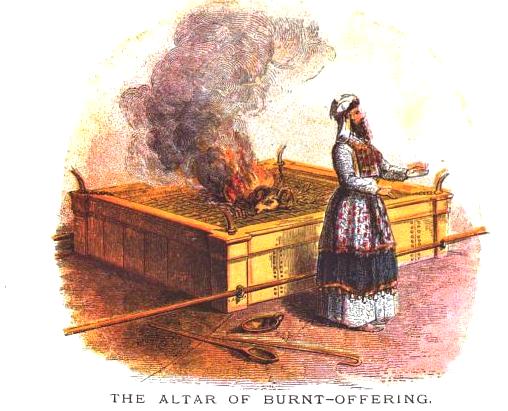
▸ Most sacrifices are dead before they are placed on the altar.  In this case, I must be alive, but my “self” or “self-focus” must be dead – totally yielded to Christ
▸ I must put myself on the altar knowing that I am submitting to the fire’s refinement.

If you can survive the imagery (burning flesh on the fire doesn’t really sound inviting), it begs the question, “how can I ever hope to present my body as a living sacrifice?”

The answer is found, in part, in 2 Corinthians 5:21.  “For He made Him who knew no sin to be sin for us, that we might become the righteousness of God in Him.”  We are able to become righteous . . . an acceptable sacrifice by the shed blood of Jesus, the perfect sacrifice, slain once for all.

I find more insight in Galatians 2:20 which reminds me that “I have been crucified with Christ; it is no longer I who live, but Christ lives in me; and the life which I now live in the flesh I live by faith in the Son of God, who loved me and gave Himself for me.  This sacrificial life will be by faith in the One who already proved his love, His sacrifice.

Finally, I am told in Colossians 2:6-7, “As you have therefore received Christ Jesus the Lord, so walk in Him,  rooted and built up in Him and established in the faith, as you have been taught, abounding in it with thanksgiving.  The key to my being a living sacrifice is to walk in Christ, in His Word.  To be rooted in and built up in the experiential knowledge of Christ.  Then shall I be able to live this sacrificial life.

Philippians 3:8 Yet indeed I also count all things loss for the excellence of the knowledge of Christ Jesus my Lord, for whom I have suffered the loss of all things, and count them as rubbish, that I may gain Christ!

Read Full Post »

Romans 12, verses 1 and 2 are familiar and yet shrouded, within my grasp but elusive.

1 I beseech you therefore, brethren, by the mercies of God, that you present your bodies a living sacrifice, holy, acceptable to God, which is your reasonable service.
 2 And do not be conformed to this world, but be transformed by the renewing of your mind, that you may prove what is that good and acceptable and perfect will of God.

OBSERVATIONS:

Present your bodies . . .

∙ This is a commandsomething I  “must do” rather than merely “should do”
∙ Something is required of me
∙ The implication of the command is that my body is under my control, subject to my will
∙ This involves the discipline of self-control, a fruit of the Spirit in my life (Galatians 2:22-23)

We are not in this alone.  In Ephesians 2:8-10, Paul assures us, “for by grace you have been saved through faith, and that not of yourselves; it is the gift of God,  not of works, lest anyone should boast.  For we are His workmanship, created in Christ Jesus for good works, which God prepared beforehand that we should walk in them.   The things God would like me to do are not without meaning or import . . . they are my purpose, my destiny . . . God’s best plan for me.

When I feel I cannot obey this command, Jesus is my example.  I am told by the writer of  Hebrews, to lay “aside every weight, and the sin which so easily ensnares us, and . . . run with endurance the race that is set before us,  looking unto Jesus, the author and finisher of our faith, who for the joy that was set before Him endured the cross, despising the shame, and has sat down at the right hand of the throne of God.  For consider Him who endured such hostility from sinners against Himself, lest you become weary and discouraged in your souls.


Read Full Post »

But you are a chosen generation, a royal priesthood, a holy nation, His own special people, that you may proclaim the praises of Him who called you out of darkness into His marvelous light.   1 Peter 2:9

high priest

Peter, for all his awkwardness during the earthly ministry of Jesus, definitely pulled things together when he wrote his epistles.  This verse in his first epistle is just marvelous.  The whole section in 1 Peter 2 is worth an in-depth study.  The mention of us (the church) being a priesthood is especially interesting given its very “Jewish”  flavor.

Of course, there is nothing new under the sun and Peter lifted this imagery, probably very intentionally, from Exodus  19:5-6 where Moses is given this to tell the children of Israel by God:

 ‘Now therefore, if you will indeed obey My voice and keep My covenant, then you shall be a special treasure to Me above all people; for all the earth is Mine. And you shall be to Me a kingdom of priests and a holy nation.’ These are the words which you shall speak to the children of Israel.”

A couple of quick observations:

  • Priests in the Old Testament had privileges that no other member of the society Israel, namely they were the only ones with access to God and the only ones allowed to make sacrifices to God
  • The limited access to God of the Old Testament was represented by the separations in the Tabernacle (Gate, Court, Holy Place, Most Holy Place) and later the temple.  The veil represented the separation between God and man.  Only the High Priest could go past the veil into the Most Holy Place and then only once a year to make atonement for the people
  • When Jesus died on the cross, the veil was torn and the separation between God and man was removed
  • We have access to God by the shed blood of Jesus on the cross
Peter reminds us from whence we have come:  who once were not a people but are now the people of God, who had not obtained mercy but now have obtained mercy.  1 Peter 2:10  It is good news!

As a final thought, let us consider our purpose as this “chosen generation,”  “this royal priesthood,” and “this holy nation.”  For Peter does tell us the why:  “that you may proclaim the praises of Him who called you out of darkness into His marvelous light.”  1 Peter 2:9

Read Full Post »

« Newer Posts - Older Posts »