In Exodus, God gives Israel the Torah (instructions). Many have translated this “law,” but Torah is much more than law. It is the hedges God has given His people for the abundant life, the God-pleasing life. The Torah was a gift to man, to help him to realize his total inability to meet God’s standard and his obvious and ongoing need for a Savior . . . who bleeds. According to Paul, the “law was our tutor to bring us to Christ, that we might be justified by faith.” Galatians 3:24
The atonement provided for under the law was only intended as a temporary fix, to cover the sin in order that the worshiper might approach and fellowship with God. It was never intended to take sin away.
In Leviticus, an often overlooked book of the Bible, God lays out a means by which man may atone for sin in order to be able to have restored relationship with God. He sets up the place for fellowship (Mercy Seat) – where He will meet with man – through His representative (the High Priest). He carefully details every piece of wood, precious stone, curtain, garment, utensil of the worship.
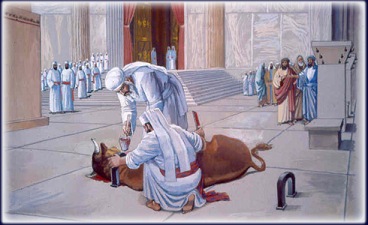
The starting point of the worship of God was the bronze altar where the sacrifices were made. It was a bloody place. At the time of the feasts, the valley behind the temple would have been flowing with blood from the many sacrifices being offered. Shed blood was a central part of the worship and approach to God. No one entered the presence of God without a blood covering, a sacrifice to atone for sin.
God told His people in Leviticus 17:11, “For the life of the flesh is in the blood, and I have given it to you upon the altar to make atonement for your souls, for it is the blood that makes atonement for the soul.”
All this was looking forward to the cross, the shed blood of the Lamb of God, the blood that would atone for the sin of the whole world.
Check out our next blog for more about The Resurrection.
It is our desire to help you grow in your knowledge of Adonai and His Word. If you are looking for additional information and/or materials, please visit our website at RootedinHisWord.org and our Facebook page.
Before Creation, before man was in need of a Savior, there existed a God who loved. The celebration of the Resurrection of Christ (the Messiah) is about God’s love.
The need for the passion and Resurrection of Jesus is first revealed in Genesis 3:15. When man violated the one command God had given him, man’s perfect fellowship with God was broken. Easter represents his one way back to that fellowship.
God is holy. Sinful man cannot approach or have a close relationship with a holy God. Such sin is an abomination to God. Just as darkness and light cannot co-exist in the physical realm, so too holiness and sin cannot co-exist in the spiritual realm.
In the chapters of Genesis, the reader is given plenteous evidence why a Savior is needed. In only a few generations, the heart of man was so far from God that God Himself said, “the wickedness of man [is] great in the earth, and . . . every intent of the thoughts of his heart [is] evil continually.”
Man, without God, is hopelessly unable obtain righteousness. God is just. He will judge evil and sin as seen in the worldwide flood, the confusion of language at the tower of Babel and the destruction of Sodom and Gomorrah.
The wages or payment for sin is death. Romans 6:23.
It is appointed for men to die once, but after this, the judgment. Hebrews 9:24
Don’t lose hope. This is not the end of the story. Check out our next post for more of the salvation story unfolding.
It is our desire to help you grow in your knowledge of Adonai and His Word. If you are looking for additional information and/or materials, please visit our website at RootedinHisWord.org and our Facebook page.
As you prepare your heart for the coming time of remembrance of the passion of Yeshua HaMoshiach (Jesus the Christ) and celebration of Resurrection Sunday (Easter), we refer you to some of our prior posts on the subject:
It is our desire to help you grow in your knowledge of Adonai and His Word. If you are looking for additional information and/or materials, please visit our website at RootedinHisWord.org and our Facebook page.
As we approach the celebration of Yeshua’s arrest, trial(s), passion, burial and resurrection, evaluate your Bible Literacy–take the Easter Quiz and then check your results against the Answer Key
It is our desire to help you grow in your knowledge of Adonai and His Word. If you are looking for additional information and/or materials, please visit our website at RootedinHisWord.org and our Facebook page.
Read Numbers 19 1. According to Numbers 19:9, what is the use of the ashes of the Red Heifer to be?
2. Describe one thing that you learned about ceremonial cleanness or uncleanness from this chapter.
Read Numbers 20 1. Where are the children of Israel at the beginning of this chapter?
2. What were the people complaining to Moses and Aaron about in the beginning verses of this chapter? What is the response of Moses and Aaron? God?
3. How does Moses go wrong with the rock? What does God tell him in Numbers 20:12? 4. What does God say about obedience in the following verses: □ 1 Samuel 15:22-23
□ Proverbs 21:3 □ John 14:15, 23
5. Describe the events of Numbers 20:14-21?
6. What happens in Numbers 20:22-29? Where is Aaron buried?
It is our desire to help you grow in your knowledge of Adonai and His Word. If you are looking for additional information and/or materials, please visit our website at RootedinHisWord.org and our Facebook page.
Sabbath . . . the epitome of God’s law, even as it is the external, most eloquent symbol of our allegiance to God in all our activities in the physical world and in human society. The Sabbath educates the . . . individual toward godliness.
Read Numbers Chapter 18
1. What does God tell them to do with His heave offerings and the holy gifts of the children of Israel?
2. What does God say about the wave offerings? The best of the oil, new wine and grain? First fruits?
3. What limitation does God put on who can eat the above offerings and gifts?
4. Copy Numbers 18:20. Meditate on what it means for God to be their portion and your inheritance. How does this apply to believers in Yeshua (Jesus) today?
5. What do you learn about inheritance from the following verses?
□ Psalm 33:12
□ Ephesians 1:11
□ 1 Peter 1:3-5
It is our desire to help you grow in your knowledge of Adonai and His Word. If you are looking for additional information and/or materials, please visit our website at RootedinHisWord.org and our Facebook page.
Sabbath puts a halt to our labors by explicit command of God, this cessation from “creating” work on our part implies we place all our actions, along with the world . . . at the feet of God.





 Rooted and Grounded