Feeds:
Posts
Comments

Read Hosea Chapter 8
1. What does God tell Hosea to do in Hosea 8:1? Why?

2. What were the reasons and occasions for blowing the trumpet in Numbers 10:8-10?

3. What does Ezekiel 33:1-11 teach about those who fail to heed the warning of the trumpet?

4. What does God say Israel will cry out to Him in Hosea 8:2?

5. What does God say of their kings in Hosea 8:4? Their princes?

6. What is the pagan calf of Samaria? (Hint: See 1 Kings 12:25-31)

7. What does God say about the calf in Hosea 8:5-6?

8. Copy of Hosea 8:7 here. Meditate on this. Record your thoughts and impressions.

9. What do the following verses teach about sowing and reaping?
Proverbs 22:8
Jeremiah 17:10
Galatians 6:7-9
Revelation 20:12

10. For what is God judging Israel according to Hosea 8:8-14?

Read Deuteronomy 28:58-68
1. What does God require of His people according to Deuteronomy 28:58?

2. What is the punishment for failing to do what God requires according to this passage?

3. How does this passage in Deuteronomy relate to what Hosea is prophesying?

Read 2 Kings 17:1-6; 22-23
1. What has happened according to 2 Kings 17:1-6?

2. What happened to Israel according to 2 Kings 17:22-23?

3. How does this relate to what Hosea has been prophesying?

 For you were once darkness, but now you are light in the Lord. Walk as children of light. . .  Ephesians 5:8

Some days, you were once darkness is an easier truth than now you are light in the Lord.

When I consider things that I sometimes do and say, light is hardly the description I would apply.

What does it mean to walk as children of light?

In Galatians, Paul tells “But the fruit of the Spirit is love, joy, peace, longsuffering, kindness, goodness, faithfulness, gentleness, self-control. Against such there is no law. And those who are Christ’s have crucified the flesh with its passions and desires. If we live in the Spirit, let us also walk in the Spirit. Let us not become conceited, provoking one another, envying one another.” Galatians 5:22 to 26

When I consider the fruit of the Spirit, I know it is only possible to have that fruit when I allow the Spirit of God to flow in and through me. For this to occur, I must have a pure heart and clean hands–I must keep short accounts with God.

It is a lot to consider, but allowing the Spirit of God to move in and take up residence in my heart, my being (and booting out the old tenants) seems like a good way to start.

P1010080 

Read Hosea Chapter 7
1. What does God say is happening in Ephraim and Samaria in Hosea 7:1-3?

2. What does God say about His people in Hosea 7:4-7?

3. What does God accuse Ephraim of doing in Hosea 7:8?

4. What has happened to Ephraim according to Hosea 7:9?

5. What do God’s people NOT do according to Hosea 7:10?

6. What is Ephraim compared to in Hosea 7:11? Why?

7. What does God say He will do in Hosea 7:12?

8. Why does God judgment them according to Hosea 7:13-16?

9. Copy Hosea 7:15 here. Meditate on this. Record your thoughts and impressions.

10. How do these chapters speak to you about your life and relationship with God? What does God require of us? Of you?

Read Hosea Chapter 6
1. What will God’s people be saying to themselves according to Hosea 6:1-3?

2. What is God’s response according to Hosea 6:4-6? Why?

3. Copy Hosea 6:6 here. Meditate on this. Record your thoughts and impressions.

4. What are the accusations God makes in Hosea 6:7-11? Why?


If you are looking for additional information and/or materials, please visit our website at RootedinHisWord.org and our Facebook page.  We are currently offering a special on our bible study, Road to Resurrection, which helps the student to delve into the events which took place leading up to and on the Day of Resurrection.

34857624_201435477340473_855160484356161536_n

Do you have faith?

“I assure you and most solemnly say to you, if you have faith [personal trust and confidence in Me] and do not doubt or allow yourself to be drawn in two directions, you will not only do what was done to the fig tree, but even if you say to this mountain, ‘Be taken up and thrown into the sea,’ it will happen [if God wills it]. And whatever you ask for in prayer, believing, you will receive.” Matthew 21:21-22 (Amplified)

Faith doesn’t allow itself to be drawn in two directions. The man or woman of faith knows God and follows hard after God. That is the only direction.

Faith gives no assent to any thought or philosophy that questions or undermines the sovereignty of God. That man is unstable. As James said, “let him ask in faith, with no doubting, for he who doubts is like a wave of the sea driven and tossed by the wind. For let not that man suppose that he will receive anything from the Lord; he is a double-minded man, unstable in all his ways.” James 1:6-8 (NKJV)

Faith isn’t a feeling, not even a strong desire or belief in something good–faith is an action, a way of living. Faith speaks to the fig tree because the fig tree is under God’s sovereignty and when the man of God speaks to the creation of God within the perfect will of God, trees wither, mountains move. Prayers are answered.

Prayer is a great way of exercising faith in God’s economy. Prayer is a faith-action that God will do as He has said He will–those who seek will find, those who ask will receive and to those who knock, the door will be opened. Faith believes that promise and seeks, asks and knocks. Faith believes God–about everything.

P1030180

Mountains of Alaska (near Denali Park)


Read Hosea Chapter 5
1. Against whom is Hosea prophesying judgment in this chapter?

2. Who is Mitzpah?

3. What is Tabor?

4. Who is Ephraim? Where is the land allotted to Ephraim located in Israel?

P1050396

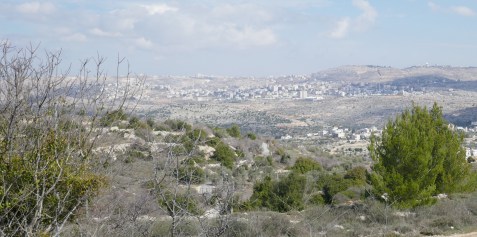
View near Bethel

5. What does God accuse Ephraim of in Hosea 5:3?

Israel?

6. What does God say is the reason for His judgment in Hosea 5:4-5?

Hosea 5:6-7?

Hosea 5:11?

Hosea 5:13?

8. What will the judgment be according to Hosea 5:6?

Hosea 5:9?

Hosea 5:12?

Hosea 14-15?

9. In the territory of which tribe are the following places located: Gibeah, Ramah, and Beth Aven?

10. To what does God compare Judah in Hosea 5:10? What does that mean?

11. What do you learn from the following verses?
Deuteronomy 19:14

Deuteronomy 27:17

Proverbs 23:10-11


Do you question God?

It is in the heart of every man and woman to question God. It is His longsuffering and mercy that lull us into the sense that it is our right to question Him. Those of us raised in America have “authority-challenge” in our blood.

We desire to rail against God and alternately plead with Him when situations go out of our control, beyond our resources–like in a global pandemic. We want to rush into His presence and have our say.

But how can a sinful person be in the presence of a holy God?

But without the shedding of blood, there is no atonement for sin. (Leviticus 17:11) Without atonement for sin, there is no approaching a holy God. Without a way to approach God, we are left shouting our complaints and pleas to the ceiling, to the social media abyss.

The only way to approach God is on His terms, in the way He has defined. It is only blood that can open the way–blood of an acceptable sacrifice. One might ask if an animal sacrifice will suffice–not if you don’t have a God-ordained place to offer it. No sanctuary–no sacrifice.

What hope is left? One sacrifice has been accepted by God–the blood shed by Jesus the Christ. He was without sin and offered His life as payment for the sins of the whole world.

If you believe He was who He said He was–the Son of God (God incarnate) and that He died sacrificially for the sins of all men, then when you acknowledge your condition–separated from God by your sin, you can come under the covering of His blood and be cleansed of your sin and acceptable in the sight of God. You need only believe. No works are required.

Believe and be saved.


For I determined not to know anything among you except Jesus Christ and Him crucified.
1 Corinthians 2:2 NKJV

Paul’s statement is worth considering as we sit here in time less than a week out from the celebration of the Passion of the Christ.

What is Paul on about?

The words, “I determined,” speak of a choice. The fact that there was a choice implies that there were other ways Paul could have approached his ministry. For example, he could have tried to be relevant to his audience, modify his message to fit the population, work to attract the world to Jesus and the message of the cross. He could have employed music or drama to appeal to their tastes and make the crucifixion palatable.

But instead, he chose to put aside all rhetoric. This was no small thing because as a Jewish student of the law, he had been trained since a very early age to make arguments and support his position with theological statements of great thinkers from the past. It would have been well within his strength and religious training. He chose instead to let the cross speak for itself.

“[N]ot to know anything among you except Jesus Christ and Him crucified,” speaks of a singleness of focus. It speaks of intentionality of thought. Why would he be so narrow in his focus? Perhaps because he knew the liberty of the cross–he himself had been a slave to the law, and had found great freedom in Christ. He wanted that for others. It might also have been the exigency of time that he felt. He may have felt that making the main thing the plain thing was the best use of time. Perhaps he knew the time was short before Christ would return for His church and Paul wanted as many to be ready as was possible.

Paul gives voice to his focus in Galatians 2:20, “I have been crucified with Christ; it is no longer I who live, but Christ lives in me; and the life which I now live in the flesh I live by faith in the Son of God, who loved me and gave Himself for me.” Paul saw that the cross changed how one lived in the temporal.

The cross presents a rift in the fabric of eternity–a fracture in the seemingly unchangeable progression of humanity from the garden forward. At the cross, the futility of the life of man has an end. It is possible for him to be no longer a vapor; no longer like the grass. At the cross, the human soul finds its potential to become a companion of God . . . forever.

Human argument is silenced by this horrific act of God.

IMG_4121

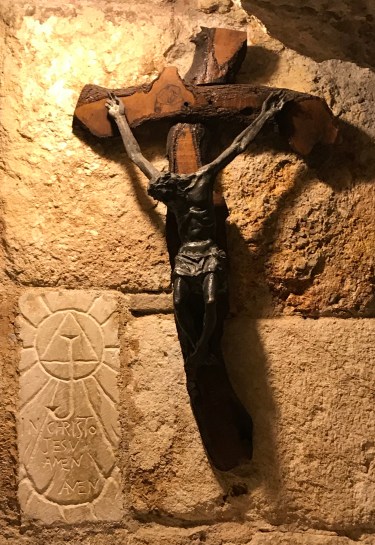
Even if you didn’t understand the sacrificial system under Mosaic law or the significance of the tearing of the veil in the Holy of Holies, granting access to God directly for the first time since God gave instructions for the building of the Tabernacle in the wilderness–the Son of God, beaten within inches of His human life, hung on a Roman cross in a rock quarry like a common criminal has to draw your attention.

Paul “determined not to know anything . . .  except Jesus Christ and Him crucified” because that was all that mattered. It is still all that matters.

The glorious thing about the suffering, death and resurrection of Jesus the Christ is that it continues to speak in our hearts. Even today, modern hymn writers are still penning lyrics of the glory of the resurrection and our hope in Christ alone.

My favorite part of this song is “There in the ground His body lay, Light of the world by darkness slain; Then bursting forth in glorious day, up from the grave He rose again!
And as He stands in victory, Sin’s curse has lost its grip on me.” When I sing it, I am reminded of the glory of God and His great power over death.

CHORUS:
In Christ alone my hope is found;
He is my light, my strength, my song;
This cornerstone, this solid ground,
Firm through the fiercest drought and storm.
What heights of love, what depths of peace,
When fears are stilled, when strivings cease!
My comforter, my all in all—
Here in the love of Christ I stand.

In Christ alone, Who took on flesh,
Fullness of God in helpless babe!
This gift of love and righteousness,
Scorned by the ones He came to save.
Till on that cross as Jesus died,
The wrath of God was satisfied;
For ev’ry sin on Him was laid—
Here in the death of Christ I live.

There in the ground His body lay,
Light of the world by darkness slain;
Then bursting forth in glorious day,
Up from the grave He rose again!
And as He stands in victory,
Sin’s curse has lost its grip on me;
For I am His and He is mine—
Bought with the precious blood of Christ.

No guilt in life, no fear in death—
This is the pow’r of Christ in me;
From life’s first cry to final breath,
Jesus commands my destiny.
No pow’r of hell, no scheme of man,
Can ever pluck me from His hand;
Till He returns or calls me home—
Here in the pow’r of Christ I’ll stand.

Words by Stuart Townend (1963-   )

If you are looking for additional information and/or materials, please visit our website at RootedinHisWord.org and our Facebook page.  We are currently offering a special on our bible study, Road to Resurrection, which helps the student to delve into the events which took place leading up to and on the Day of Resurrection.

34857624_201435477340473_855160484356161536_n

Looking toward the celebration of Resurrection Sunday, let me share some thoughts from A.W. Tozer from his powerful book, Paths to Power

According to Tozer, “there are some things that only God can do, and for us to attempt to do them is to waste our efforts; and there are things which only man can do, and for us to ask God to do them is to waste our prayers.

Among the things which only God can do, of first importance to us is the work of redemption. Atonement was accomplished in that holy place where none but a divine Savior could come. That glorious work owes nothing to the effort of any man . . . It was all of God, and man could simply have no part.

Redemption is an objective fact. It is a work potentially saving, wrought for man, but done independent of and exterior to the individual. Christ’s work on Calvary made atonement for every man, but it did not save any man. . .  (Emphasis added)

If atonement was made for all men, why are not all saved? The answer is that before redemption becomes effective toward the individual man there is an act which that man must do. . . God cannot do our repenting for us.  . . God has commanded all men to repent. It is a work which only they can do. It is morally impossible to one person to repent for another. Even Christ could not do this. He could die for us, but He cannot do our repenting for us.”

As you look forward to the celebration of the Resurrection, consider the atonement–have you appropriated it for yourself? Have you repented of your sin? Repentance is a godly sorrow over sin and a turning from the sin. It is actually the idea of making a u-turn and going 180 degrees in the opposite direction from which you were traveling to follow God.

If you have assurance of salvation, then be praying for those for whom Christ died but who have not yet appropriated the free gift of salvation and have not repented for their sin. It is a great time to remember that God desires that none would perish but that all would come to repentance.

If you are looking for additional information and/or materials, please visit our website at RootedinHisWord.org and our Facebook page. We are currently offering a special on our bible study, Road to Resurrection, which helps the student to delve into the events which took place leading up to and on the Day of Resurrection.

34857624_201435477340473_855160484356161536_n