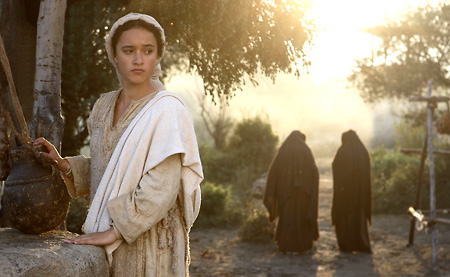
- What horrible news does Joseph receive in Matt. 1:18?
- How does Joseph come to terms with Mary’s pregnancy according to Matt. 1:19-25?
- Read Luke 1. According to Luke 1:26, who came as a messenger from God to Mary?
- Where was Mary living at the time of this story?
- To whom was Mary betrothed? Of what lineage was her betrothed?
- How does Gabriel greet Mary in verse 28?
- What is her reaction in verse 29?
- For what job has Mary been chosen according to verse 31?
- How does Gabriel describe Jesus and what He will do in verses 32-33?
- What is Mary’s very practical question in verse 34?
- What is Gabriel’s response in verse 35?
- What separate proof of the authenticity of his message does Gabriel offer in verse 36?
- What is Mary’s response to the message from God through Gabriel in verse 38?
- Who does Mary go to visit during her pregnancy according to Luke 1:36-41? Why?
- What happens to Elizabeth when she hears Mary’s voice? Why is that significant?
Posts Tagged ‘New Testament’
Christmas Preparation Part 1: The Announcement, threats of divorce, visit to relatives
Posted in Bible, Bible Basics, Bible Study, Books of the Bible, Christmas, God, Jesus, Luke, Matthew, New Testament, tagged Angel Gabriel, Bible, Bible Study, Christmas, Christmas Bible Study, Christmas Story, Gospel of Luke, Gospel of Matthew, Mary, New Testament on December 11, 2011|
Thanksgiving Preparation (Day 2)
Posted in Bible, Bible Basics, God, New Testament, Thanksgiving, tagged Bible, New Testament, Preparation for Thanksgiving, Thanking God, Thanksgiving, What Christ has done on November 22, 2011|
• Romans 6:23 For the wages of sin is death, but the gift of God is eternal life in Christ Jesus our Lord.
• 2 Corinthians 5:21 For He made Him who knew no sin to be sin for us, that we might become the righteousness of God in Him.
• Ephesians 1:3 Blessed be the God and Father of our Lord Jesus Christ, who has blessed us with every spiritual blessing in the heavenly places in Christ
• 1 Peter 1:3-5 Blessed be the God and Father of our Lord Jesus Christ, who according to His abundant mercy has begotten us again to a living hope through the resurrection of Jesus Christ from the dead, 4 to an inheritance incorruptible and undefiled and that does not fade away, reserved in heaven for you, 5 who are kept by the power of God through faith for salvation ready to be revealed in the last time.
Living between two mountains: Sinai and Zion
Posted in Attributes, Bible, Exhortation, God, Holiness, Jesus, Knowing God, Lover of my soul, New Testament, Old Testament, the Father, Walking with God, tagged Bible, Judgment of God, Love of God, Mt Sinai, Mt. Zion, New Testament, Old Testament on October 1, 2011|
Mount Sinai
Mount Sinai is the backdrop for Israel’s receipt of the Law. The mountain is where God met Moses and is primarily characterized by fire:
- Mount Sinai was completely in smoke, because the LORD descended upon it in fire. Its smoke ascended like the smoke of a furnace, and the whole mountain quaked greatly. Exodus 19:18
- The sight of the glory of the LORD was like a consuming fire on the top of the mountain in the eyes of the children of Israel. Exodus 24:17
- Then you came near and stood at the foot of the mountain, and the mountain burned with fire to the midst of heaven, with darkness, cloud, and thick darkness. Deuteronomy 4:11
- The LORD talked with you face to face on the mountain from the midst of the fire. Deuteronomy 5:4
- Then the LORD delivered to me two tablets of stone written with the finger of God, and on them were all the words which the LORD had spoken to you on the mountain from the midst of the fire in the day of the assembly. Deuteronomy 9:10
- Remember Your congregation, which You have purchased of old, The tribe of Your inheritance, which You have redeemed-This Mount Zion where You have dwelt. Psalm 74:2
- But chose the tribe of Judah, Mount Zion which He loved. Psalm 78:68
- Those who trust in the LORD Are like Mount Zion, Which cannot be moved, but abides forever. Psalm 125:1
- And it shall come to pass That whoever calls on the name of the LORD Shall be saved. For in Mount Zion and in Jerusalem there shall be deliverance, As the LORD has said, Among the remnant whom the LORD calls. Joel 2:32
- Then I looked, and behold, a Lamb standing on Mount Zion, and with Him one hundred and forty-four thousand, having His Father’s name written on their foreheads. Revelation 14:1
Paul makes the case for the two mountains in his letter to the Hebrews:
But you have come to Mount Zion and to the city of the living God, the heavenly Jerusalem, to an innumerable company of angels, to the general assembly and church of the firstborn who are registered in heaven, to God the Judge of all, to the spirits of just men made perfect, to Jesus the Mediator of the new covenant, and to the blood of sprinkling that speaks better things than that of Abel.
See that you do not refuse Him who speaks. For if they did not escape who refused Him who spoke on earth, much more shall we not escape if we turn away from Him who speaks from heaven, whose voice then shook the earth; but now He has promised, saying, “Yet once more I shake not only the earth, but also heaven.” Now this, “Yet once more,” indicates the removal of those things that are being shaken, as of things that are made, that the things which cannot be shaken may remain. Therefore, since we are receiving a kingdom which cannot be shaken, let us have grace, by which we may serve God acceptably with reverence and godly fear. For our God is a consuming fire. Hebrews 12:18-29
It is the same God of both mountains, so we should keep both mountains in view:
- one where God laid down His law, a place of judgment.
- one where God laid down His life, a perfect sacrifice, a place of love, grace, mercy and forgiveness.
I can see clearly now . . .
Posted in Bible, Bible Study, God, Gospels, Knowing God, Luke, New Testament, tagged Bible Study, Gospel of Luke, New Testament, Peter and Jesus, power of God on September 26, 2011|
But Simon answered and said to Him, “Master, we have toiled all night and caught nothing; nevertheless at Your word I will let down the net.” And when they had done this, they caught a great number of fish, and their net was breaking. So they signaled to their partners in the other boat to come and help them. And they came and filled both the boats, so that they began to sink. When Simon Peter saw it, he fell down at Jesus’ knees, saying, “Depart from me, for I am a sinful man, O Lord!” For he and all who were with him were astonished at the catch of fish which they had taken; and so also were James and John, the sons of Zebedee, who were partners with Simon. And Jesus said to Simon, “Do not be afraid. From now on you will catch men.” Luke 5:3-10
What do you observe from the passage?
When confronted with evidence of God’s power, we cannot but notice our inadequacy, our humanity. Like Peter, we may have fished the same lake for 20 years, so we humor the “novice” who asks us to put out nets in way past the best hour to fish and then find that we knew nothing of what we thought was our field of expertise. That’s how it is when God shows up. All our best efforts, our worldly wisdom, our expertise are nothing more than a vapor.
Jesus’ last words to them are words of hope, words that speak to their future not their failures. Thank you Jesus that You always see us in terms of our future (with You) and not our failures.
Quiet in our Spirit
Posted in Bible, General Epistles, New Testament, tagged 1 Peter 3, General Epistle, New Testament, quiet in spirit, wives on September 17, 2011| 2 Comments »
I don’t know about you, but I have plenty to say most of the time. When I think that quiet will forever escape me, I am reminded that God calls me to be quiet in my spirit.
He goes on to say, “Do not let your adornment be merely outward–arranging the hair, wearing gold, or putting on fine apparel– rather let it be the hidden person of the heart, with the incorruptible beauty of a gentle and quiet spirit, which is very precious in the sight of God.”
So I learn that God likes me to be quiet in my spirit, to work on my inner beauty and to seek to have beauty that doesn’t call attention to itself.
Quiet in our daily lives
Posted in Bible, Devotional, Exhortation, New Testament, Paul's Epistles, Prayer, Timothy, tagged 1 Timothy 2, being quiet, Bible, Books of the Bible, Devotional, intercession, New Testament, Prayer, Relationship with God, supplication on September 12, 2011|
Is your life crazy busy? Do you have a husband, kids, grandkids a house, a job, another job or just commitments? We live busy lives, spent rushing from one thing to the next with little time for spiritual disciplines like prayer, fasting, Bible study or simply listening to God.
In his letter to Timothy in 1Timothy 2:1-4, Paul offers some ideas on how to have “quiet” in our daily lives, and he provides the rationale for doing so. “I exhort first of all that supplications, prayers, intercessions, and giving of thanks be made for all men, for kings and all who are in authority, that we may lead a quiet and peaceable life in all godliness and reverence. For this is good and acceptable in the sight of God our Savior, who desires all men to be saved and to come to the knowledge of the truth.”
How do I have “quiet”?
- Supplications (humble prayer, entreaty, or petition)
- Prayers (a spiritual communion with God)
- Intercessions (a prayer to God on behalf of another)
- Giving thanks for all men, for kings and all who are in authority
- It is acceptable in the sight of God our Savior
Quiet in His Strength
Posted in Bible, Exhortation, God, Matthew, New Testament, Walking with God, tagged Bible, Devotional, Exhortation, Jesus, Matthew, New Testament, rest, Yoke on September 10, 2011|
Sometimes we are told to “Make a joyful shout to the LORD” (Psalm 100) and “Praise Him with clashing cymbals! (Psalm 150)” Other times, we can be quiet.
We can be quiet in His strength
In Matthew 11:28, Jesus says, “Come to Me, all you who labor and are heavy laden, and I will give you rest. 29 “Take My yoke upon you and learn from Me, for I am gentle and lowly in heart, and you will find rest for your souls. 30 “For My yoke is easy and My burden is light.”
The picture here is of oxen pulling a plow or a wagon. The two animals would be yoked together. A yoke is “a device for joining together a pair of draft animals, especially oxen, usually consisting of a crosspiece with two bow-shaped pieces, each enclosing the head of an animal.” In order to be yoked together, animals must be comparable in size, stamina and desire to work. This provides an important spiritual lesson to the believer.
When we are yoked to Jesus, we go where He goes (by necessity). Because of the yoke, we must look at what He looks at, see what He sees. By being joined together like this, we benefit from His wisdom and His strength, and we can just be quiet. Sometimes it is good to just walk alongside Jesus, yoked to Him, quietly learning from Him.
Biblical Faith, what is it?
Posted in Bible, Bible Study, Faith, General Epistles, Hebrews, Hope, New Testament, tagged Bible Study, Biblical Faith, Faith, Faith in God, Hebrews 11, hope, New Testament on September 6, 2011|
- It is not mere hopefulness
- It is not mere optimism
- It is not merely a hunch
- It is not merely an emotional sentiment
- Biblical faith makes the future present
- Biblical faith makes the invisible seen
- Biblical faith can grow
- Biblical faith has God as its object
- Biblical faith has God’s Word as its assurance
- Biblical faith gives evidence for what can’t be seen
- Biblical faith is a gift from God, not based on experience or works
- Biblical faith has a certainty – being sure of what we hope for:
- Forgiveness of sins
- Acceptance into heaven
- Rewards for faithful service
- Living with settled conviction of His promises
- Taking God at His word
- Biblical faith takes hold of the future and lives based on the future now
Bible Basics – New Testament Collection
Posted in Bible, Bible Basics, Bible Study, Books of the Bible, General Epistles, Gospels, New Testament, Paul's Epistles, tagged Bible Basics, Bible Overview, Bible Study, New Testament on August 19, 2011|
The following is a collection of the recent posts in the Bible Basics series which focused on books of the New Testament:
Bible Basics – New Testament Overview
Bible Basics – Gospels and Early Church History
Bible Basics – Paul’s Epistles (Part 1)
Bible Basics – Paul’s Epistles (Part 2)
WHAT IS SALVATION?
Posted in Bible, Born of the Spirit, Deliverer, Forgiveness, God, Hope, In times of difficulty, Jesus, Knowing God, New Testament, Relationship with God, salvation, the LORD, Uncategorized, tagged Being saved, Bible, Bible Basics, New Testament, salvation on June 11, 2011|
The Basics
- Salvation is a gift (John 3:16)
- The only Requirement is belief (John 3:16)
- Jesus is the perfect sacrifice, satisfying all the righteousness requirements of the law (2 Corinthians 5:21)
What happens?
- We’re made alive spiritually (Colossians 2:13; Ephesians 2:1)
- The charges against us are dropped (Colossians 2:14)
- We’re forgiven of all our sins (Ephesians 1:7)
- We’re purified for God to be His own (Titus 2:14)
- We’re made new – a new creation in Christ (2 Corinthians 5:17)
- Old things are gone; all things are new (2 Corinthians 5:17)
- We’re reconciled to God (restored to right relationship) (2 Corinthians 5:18; Colossians 1:21)
- We’re presented to God holy and blameless (Colossians 1:21-23)
- We receive the Kingdom of God (Luke 12:32)
- We receive lasting inheritance (1 Peter 1:4)
- We have abundant life now (John 10:10)
- We receive everything needed for life and godly living (2 Peter 1:2-11)
- We receive the power of the Holy Spirit (Acts 1:8)
- We receive weapons for warfare (Ephesians 6:10-18)
May the One who is able to keep you from stumbling, And to present you faultless Before the presence of His glory with exceeding joy keep you from stumbling and present you to God as without fault (and only God can do that).