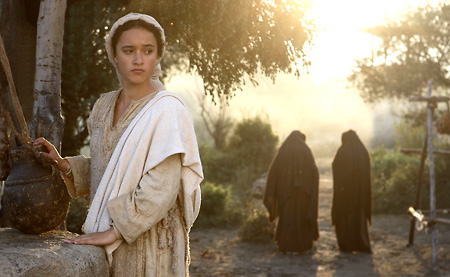
- What horrible news does Joseph receive in Matt. 1:18?
- How does Joseph come to terms with Mary’s pregnancy according to Matt. 1:19-25?
- Read Luke 1. According to Luke 1:26, who came as a messenger from God to Mary?
- Where was Mary living at the time of this story?
- To whom was Mary betrothed? Of what lineage was her betrothed?
- How does Gabriel greet Mary in verse 28?
- What is her reaction in verse 29?
- For what job has Mary been chosen according to verse 31?
- How does Gabriel describe Jesus and what He will do in verses 32-33?
- What is Mary’s very practical question in verse 34?
- What is Gabriel’s response in verse 35?
- What separate proof of the authenticity of his message does Gabriel offer in verse 36?
- What is Mary’s response to the message from God through Gabriel in verse 38?
- Who does Mary go to visit during her pregnancy according to Luke 1:36-41? Why?
- What happens to Elizabeth when she hears Mary’s voice? Why is that significant?
Archive for the ‘Bible Study’ Category
Christmas Preparation Part 1: The Announcement, threats of divorce, visit to relatives
Posted in Bible, Bible Basics, Bible Study, Books of the Bible, Christmas, God, Jesus, Luke, Matthew, New Testament, tagged Angel Gabriel, Bible, Bible Study, Christmas, Christmas Bible Study, Christmas Story, Gospel of Luke, Gospel of Matthew, Mary, New Testament on December 11, 2011|
I can see clearly now . . .
Posted in Bible, Bible Study, God, Gospels, Knowing God, Luke, New Testament, tagged Bible Study, Gospel of Luke, New Testament, Peter and Jesus, power of God on September 26, 2011|
But Simon answered and said to Him, “Master, we have toiled all night and caught nothing; nevertheless at Your word I will let down the net.” And when they had done this, they caught a great number of fish, and their net was breaking. So they signaled to their partners in the other boat to come and help them. And they came and filled both the boats, so that they began to sink. When Simon Peter saw it, he fell down at Jesus’ knees, saying, “Depart from me, for I am a sinful man, O Lord!” For he and all who were with him were astonished at the catch of fish which they had taken; and so also were James and John, the sons of Zebedee, who were partners with Simon. And Jesus said to Simon, “Do not be afraid. From now on you will catch men.” Luke 5:3-10
What do you observe from the passage?
When confronted with evidence of God’s power, we cannot but notice our inadequacy, our humanity. Like Peter, we may have fished the same lake for 20 years, so we humor the “novice” who asks us to put out nets in way past the best hour to fish and then find that we knew nothing of what we thought was our field of expertise. That’s how it is when God shows up. All our best efforts, our worldly wisdom, our expertise are nothing more than a vapor.
Jesus’ last words to them are words of hope, words that speak to their future not their failures. Thank you Jesus that You always see us in terms of our future (with You) and not our failures.
Biblical Faith, what is it?
Posted in Bible, Bible Study, Faith, General Epistles, Hebrews, Hope, New Testament, tagged Bible Study, Biblical Faith, Faith, Faith in God, Hebrews 11, hope, New Testament on September 6, 2011|
- It is not mere hopefulness
- It is not mere optimism
- It is not merely a hunch
- It is not merely an emotional sentiment
- Biblical faith makes the future present
- Biblical faith makes the invisible seen
- Biblical faith can grow
- Biblical faith has God as its object
- Biblical faith has God’s Word as its assurance
- Biblical faith gives evidence for what can’t be seen
- Biblical faith is a gift from God, not based on experience or works
- Biblical faith has a certainty – being sure of what we hope for:
- Forgiveness of sins
- Acceptance into heaven
- Rewards for faithful service
- Living with settled conviction of His promises
- Taking God at His word
- Biblical faith takes hold of the future and lives based on the future now
Bible Basics – New Testament Collection
Posted in Bible, Bible Basics, Bible Study, Books of the Bible, General Epistles, Gospels, New Testament, Paul's Epistles, tagged Bible Basics, Bible Overview, Bible Study, New Testament on August 19, 2011|
The following is a collection of the recent posts in the Bible Basics series which focused on books of the New Testament:
Bible Basics – New Testament Overview
Bible Basics – Gospels and Early Church History
Bible Basics – Paul’s Epistles (Part 1)
Bible Basics – Paul’s Epistles (Part 2)
Bible Basics – Old Testament overview
Posted in Bible, Bible Basics, Bible Study, Books of the Bible, Deuteronomy, Genesis, God, Knowing God, Law, Leviticus, Old Testament, tagged Bible Basics, Bible Study, Book of Chronicles, Book of Kings, Book of Samuel, Deuteronomy, Divisions of Old Testament, Esther, Exodus, Genesis, Isaiah, Jeremiah, Leviticus, Nehemiah, Numbers, Old Testament, Old Testament Overview, Proverbs, Psalms, Ruth, the Pentateuch on August 7, 2011|
One of the purposes of this blog is to provide accurate information about the Bible in an easy-to-understand format.
The following are links to the posts in the Bible Basics – Old Testament Overview series:
Gospel of John (John 1:5 – more on the light)
Posted in Bible, Bible Study, Books of the Bible, Gospels, John, Light, New Testament, tagged darkness, Gospel of John, John, John 3:16, Light on April 4, 2011|
John 1:5 And the light shines in the darkness, and the darkness did not comprehend it.
John uses the contrast of light and darkness is several places in his gospel. In John 3:16. he writes, “For God so loved the world that He gave His only begotten Son, that whoever believes in Him should not perish but have everlasting life. 17 For God did not send His Son into the world to condemn the world, but that the world through Him might be saved. 18 He who believes in Him is not condemned; but he who does not believe is condemned already, because he has not believed in the name of the only begotten Son of God. 19 And this is the condemnation, that the light has come into the world, and men loved darkness rather than light, because their deeds were evil. 20 For everyone practicing evil hates the light and does not come to the light, lest his deeds should be exposed. 21 But he who does the truth comes to the light, that his deeds may be clearly seen, that they have been done in God.
The condemnation is already upon those who love darkness. The reality is that those who love and practice evil don’t want light to expose them or their deeds. They prefer to hide in darkness. But from whom do they hide? From the God who created them. It has been so from the beginning. If we go back to Genesis 3:8, we read: “And they heard the sound of the LORD God walking in the garden in the cool of the day, and Adam and his wife hid themselves from the presence of the LORD God among the trees of the garden. 9 ¶ Then the LORD God called to Adam and said to him, “Where are you?” 10 So he said, “I heard Your voice in the garden, and I was afraid because I was naked; and I hid myself.” You know the rest of the story, but the point here is that those who violate God’s rules, seek to hide from God. It is this desire to hide from God that makes darkness their friend. They hate the light. It reminds them of the God they have rejected.
The good news is that just like Adam and Eve, God seeks after those who live in darkness. He would that none would perish. It is from darkness that many of us were plucked. As children of God, we bring His light into dark places. The light in us will dispel the darkness around us. That is why Jesus said, “Let your light so shine before men, that they may see your good works and glorify your Father in heaven.” Matthew 5:16
Gospel of John (John 1:5)
Posted in Bible, Bible Study, Books of the Bible, John, Light, New Testament, tagged darkness, God, Gospel of John, John, Light on April 2, 2011|
John 1:5 And the light shines in the darkness, and the darkness did not comprehend it.
The Amplified version gives some additional insight: And the Light shines on in the darkness, for the darkness has never overpowered it [put it out or absorbed it or appropriated it, and is unreceptive to it.]
The darkness has never overpowered or put out the Light although the Light does shine into the darkness, and the darkness does not receive the Light. The picture of what happens when light encounters darkness is so much a part of our daily life, that we probably don’t consider it very often. A room is dark, and then a switch is flipped and light floods the room chasing out the darkness. Where does the darkness go? Away from the light. Darkness and light cannot co-exist. It is a physical principle as well as a spiritual one.
In the Spiritual realm, much like the physical, when Light enters a person’s life by the power of the Holy Spirit, darkness can no longer dwell in that life.
The Light will always over power the darkness. Hallelujah!
Gospel of John (John 1:4 . . . application)
Posted in Attributes, Bible, Bible Study, God, John, Light, New Testament, tagged Bible, Gospel, John, Light, New Testament on March 26, 2011|
In our last post, we considered John 1:4 which says: In Him was life, and the life was the light of men.
Later in the John’s gospel, in Chapter 12, he records Jesus saying, ” I have come as a light into the world, that whoever believes in Me should not abide in darkness.” For the believer, Jesus is promising an end to living (abiding) in darkness.
Ephesians 5:8 and 11 says: For you were once darkness, but now you are light in the Lord. Walk as children of light. . . 11 And have no fellowship with the unfruitful works of darkness, but rather expose them.
What changes about light and darkness for the follower of Christ?
The believer doesn’t become a light, but rather the light in the believer’s life comes from God, from Jesus dwelling within Him. We are vessels for the light. Galatians tell us, “I have been crucified with Christ; it is no longer I who live, but Christ lives in me; and the life which I now live in the flesh I live by faith in the Son of God, who loved me and gave Himself for me.” (Gal. 2:20).
By the Spirit of God dwelling in the believer, he or she becomes a light. Jesus also said we should let our light shine, let others see the light that is in us. It is not meant to be hidden.
This little light of mine, I’m gonna’ let it shine. This little light of mine, I’m gonna’ let it shine. This little light of mine, I’m gonna’ let it shine. Let it shine! Let it shine! Let it shine!
Gospel of John (Introduction)
Posted in Bible, Bible Basics, Bible Study, Books of the Bible, Gospels, John, New Testament, tagged Gospel of John, John on March 9, 2011|
As we begin our study in the gospel of John, it is important to consider the context of this gospel and how it fits with the other eye-witness accounts of the life and ministry of Jesus.
First, let us consider where we find the Book of John in the Bible.
The Bible is divided into to sections: the Old Testament and the New Testament.
Each Testament is divided into further sections. The Old Testament has five sections: the books of the law, the books of history, the books of poetry and wisdom, the major prophets and the minor prophets.
Similarly, the New Testament can be divided into five sections: gospels, history, Pauline epistles, general epistles and the book of Prophecy.
The book of John is found in the first of the five sections of the New Testament. It is one of four gospels, namely Matthew, Mark, Luke and John. The author of the book is, not surprisingly, John. What may be surprising or confusing, as I have found from teaching the ladies in the jail, is who this “John” is. He is NOT John the Baptist. John the Baptist was not a major play in the ministry of Jesus. His own words describe what happened to his ministry when Jesus showed up on the scene, “He must increase and I must decrease.” That is exactly what happened.
John, the author of the Gospel of John, was an apostle and a disciple of Jesus. He was very young at the time Jesus was alive, and he lived to a very old age. He is also the author of four other books found in the New Testament: 1 John, 2 John, 3 John and the book of Revelation.
In our next post, we’ll consider how the gospel of John fits into the four-gospel picture of the life of Christ.
Knowing God (His love is amazing Part 3)
Posted in Attributes, Bible, Bible Study, Deliverer, Genesis, God, Love, Relationship with God, Walking with God, worship, tagged Attributes of God, Bible, God, Love of God, Relationship with God, Worship on November 26, 2010|
In Part 1 and Part 2 of this series on knowing God through looking at the attribute of His great love for us, we discussed how the scriptures of the Old and New Testament describe the love of God. In this post and those following, we will consider some of the pictures that God has used to illustrate His love.
Abraham and Isaac
One of the pictures of God’s love, actually a foreshadowing of the coming of Messiah, was the story of Abraham and Isaac. You may recall the story recounted in Genesis 22 where God tests Abraham asking him to sacrifice his son Isaac on Mount Moriah. Abraham takes his son, goes up with him to the mountain, binds his son to the altar that he built and proceeds to prepare to sacrifice his only son as God asked. As he is lowering the knife to slay his son, God stops him. God provides a substitute sacrifice (a ram caught in the thicket) instead of Isaac. This picture of God’s love is the picture of the substitutionary sacrifice. God had every right to require the first born child of his marriage to Sarah from Abraham. Nevertheless, because of His great mercy and His promises to Abraham, God provided a sacrifice to satisfy the blood requirement. This substitutionary sacrifice is seen again on Calvary, years later when Jesus died, once for all. He who knew no sin, died for those who were under sin’s curse.
Deliverance of Isarael
Another great picture of the love of God and His heart for Israel (and us for whom the wall of separation was removed by the blood of Jesus) is the deliverance of Israel from Egypt. You may recall this story from Exodus. The people of God are in captivity in Egypt. They have been reduced to slavery. Their oppressors fear them and make their life difficult. They are even forced to kill their children. God hears their cries from their bondage, and from within the their own ranks, God raises up a deliverer, Moses. By the hand of God on Moses, the people of God are delivered from their oppressors and allowed to follow their God and worship Him. This picture of God the deliverer is emphasized again and again by God in the Old Testament.
By these pictures, we begin to see God’s love. You may want to go back and read the stories in their entirety and ask God to speak to you of His great love.
In our next post, we will look at some more pictures that God provides to illustrate His gr eat and amazing love.