Feeds:
Posts
Comments

Be Teachable

Another lesson that we can take from Proverbs 4:20, My son, give attention to my words; incline your ear to my sayings, is to be teachable. In asking one to “give attention to my words” and “incline your ear to my sayings,” the writer of Proverbs is asking that the student maintain a teachable heart.

The heart is mentioned throughout scripture. Most often it is a weak organ which must be guarded and supervised to avoid problems. For example, we are told in Proverbs 4:23, keep your heart with all diligence, for out of it spring the issues of life.”

In Matthew 15:18, Jesus taught, “those things which proceed out of the mouth come from the heart, and they defile a man.”

In Luke 6:45, Jesus says, “a good man out of the good treasure of his heart brings forth good; and an evil man out of the evil treasure of his heart brings forth evil. For out of the abundance of the heart his mouth speaks.”

So how does one develop or maintain a teachable heart?

  • Avoid self-righteousness, the need to be important or right in your own eyes.
  • Avoid self-reliance. Learn that faith requires reliance on God rather than self, and that self-reliance and keep us from yielding fully to God.
  • Avoid arrogance. If you feel you are the smartest person in the room, you are not teachable.
  • Avoid laziness. Being unwilling to engage in what God is asking of us because of a lack of diligence make us unteachable as well.
  • Avoid compromise. Allowing compromise into our lives will give us a divided heart and make us unteachable.

The teachable heart desires more of God and less of self. Be teachable.

If you are looking for additional information and/or materials, please visit our website at RootedinHisWord.org and our Facebook page. 
34857624_201435477340473_855160484356161536_n

Read Obadiah Chapter 1
1. Who were the Edomites? (Hint: Genesis 25:30; 36:8)

2. Where was the land of Edom located?

3. What is the prophecy that Obadiah gives against Edom in Obadiah 1:1-7?

4. Who will be exempt from this prophecy according to Obadiah 1:8-9?

5. What is Teman? Where is it located?

6. For what is God going to judge Esau according to Obadiah 1:10-14?

7. Copy Obadiah 1:15 here. Mediate on this. Record your thoughts and impressions.

8. Where is Mount Zion?

9. What does God say will occur on Mount Zion in Obadiah 1:17?

10. What do you learn from the following verses:
Isaiah 59:20-21
Romans 11:25-26

11. What will become of the house of Jacob according to Obadiah 1:18? The house of Joseph?

12. What shall become of the house of Esau according to Obadiah 1:18?

13. What prophecy does Obadiah deliver in Obadiah 1:19-21?

14. What application can you make from this book?


If you are looking for additional information and/or materials, please visit our website at RootedinHisWord.org and our Facebook page.
34857624_201435477340473_855160484356161536_n

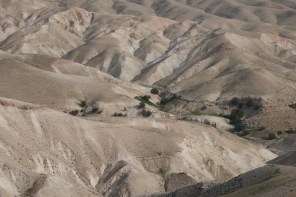
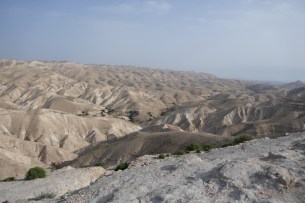
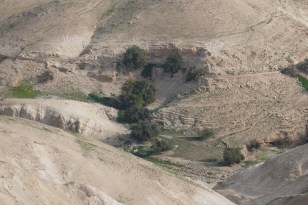
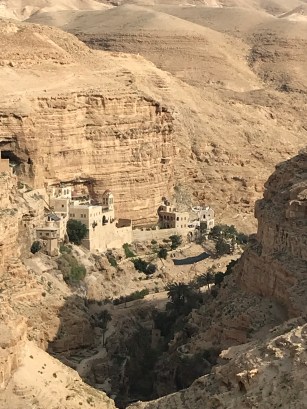
Outside of Jerusalem as you travel east, you will find Wadi Qelt. A wadi is a common feature in Israel. It is a ravine or stream bed that dries up until the raining season when it may become a rushing river or a generous stream depending on the rainfall, the run-off and the ravine itself. Wadi Qelt is such a ravine that originates near Jerusalem and extends to the Jordan River near Jericho.

Some have suggested that David may have been thinking of such a ravine when he wrote Psalm 23:4 (CJB), Even if I pass through death-dark ravines, I will fear no disaster; for you are with me; your rod and staff reassure me.

This very familiar verse reminded me of God’s guidance and correction in my life and how they prove His love for me. Moreover, my love and acceptance of God’s correction speaks of His imprint on me. In that I can see that He has brought me to this point of sanctification. I also know that He will continue to sanctify me until I am made perfect when I see Him face to face.

P1010361

Wadi Qelt

P1010354

Wadi Qelt

P1010355

Wadi Qelt

IMG_4012

Wadi Qelt

If you are looking for additional information and/or materials, please visit our website at RootedinHisWord.org and our Facebook page. 
34857624_201435477340473_855160484356161536_n

Before we begin our study of the short book of the Minor Prophet Obadiah, we will do a brief study of the background of this book.

Background
1. Who is the author of the book of Obadiah?

2. When was this book written?

3. Who was the original intended audience for this book? How do you know?

4. To which Kingdom did Obadiah prophesy, Northern or Southern?

5. To which king(s) did Obadiah minister during his career?

6. What does the name “Obadiah” mean?

P1020516

Flowers in Jerusalem


If you are looking for additional information and/or materials, please visit our website at RootedinHisWord.org and our Facebook page.
34857624_201435477340473_855160484356161536_n

Leave me, O Love, which reaches but to dust;
and thou, my mind, aspire to higher things;
grow rich in that which never taketh rust;
whatever fades, but fading pleasure brings.

Draw in thy beams, and humble all thy might
to that sweet yoke where lasting freedoms be,
which breaks the clouds, and opens forth the light,
that doth both shine and give us sight to see.

Oh, take fast hold; let that light be they guide
in this small course which birth draws out to death,
and think how evil become him to slide,
who seeketh heaven, and comes of heavenly breath.

Then farewell, world; thy uttermost I see:
Eternal Love, maintain thy life in me.

–Philip Sidney (1554-1586)

800px-Sir_Philip_Sidney_from_NPG

I don’t know about you, but in this time of great confusion and conflicting views of the important truths of our day, I find the need to seek the truth that transcends–the truth of God. Wisdom is distilled into pithy, bite-size morsels in the Book of Proverbs. As usual, it keeps its promise to provide guidance for life.

My son, give attention to my words; incline your ear to my sayings. Proverbs 4:20

In Proverbs 4:20, we receive the imperative, “Give attention to my words.” The Hebrew writing style is evident here, namely the second part of the couplet is a reiteration of the first, “incline your ear to my sayings.” The repeat of the information is an emphasis–as if the author is saying, “hey, this is important, so I’m going to repeat myself.”

If we are looking for wisdom, we need to listen to God. We need to listen to His Word. This will be the only way to survive the pandemic without losing hope or faith or our witness.

But even more than an admonition to listen, God is asking for intentionality and diligence in our approach to our relationship with Him. He is asking us to apply ourselves to the systematic study of His word.

Consider the exhortation of Paul to Timothy, “Be diligent to present yourself approved to God, a worker who does not need to be ashamed, rightly dividing the word of truth.” 2 Timothy 2:15

In order for us to “rightly divide the word of truth,” we must know all of it. We must know the Hebrew Bible (Old Testament) as well as the New Testament. We must know the Torah (first 5 books of the Old Testament) as well as the Prophets. We must know the history of both the Jews and the church.

If we are to rightly divide the word of truth, we must understand its nuance, its context, its geography, its characters. We must exert some energy–get outside of our comfort zone.

It is not a once-a-week passive attention to a sermon. It is not working through a book written about the Bible–it is reading and studying the Bible for yourself. We must let God speak to us. We must meet day by day with the Creator and Author.

Read Hosea Chapter 10
1. What does God say that Israel’s wealth has led to in Hosea 10:1?

2. Copy Hosea 10:2 here. Meditate on this. Record your thoughts and impressions.

3. What do you learn in the following passages? How do they relate to Hosea chapter 10?
Deuteronomy 8:11-14, 19?

Deuteronomy 32:16-18

4. What does God say of His people in Hosea 10:2?

5. For what does God say they are being judged in Hosea 10:4?

6. What does God say about Samaria in Hosea 10:5-8?

7. What happened at Gibeah? (Hint: Judges 19)

8. What does God say of Israel in Hosea 10:9-11?

9. Copy Hosea 10:12 here. Mediate on this. Record your thoughts and impressions.

10. Summarize Hosea 10:13-15.

IMG_1763

Peace After a Storm

When darkness long has veiled my mind,
and smiling day once more appears,
then, my Redeemer, then I find
the follow of my doubts and fears.

Straight I upbraid my wandering heart,
and blush that I should ever be
Thus prone to act so base a part
or harbor one hard thought of Thee.

Oh! Let me then at length be taught
what I am still so slow to learn;
that God is love and changes not,
nor knows the shadow of a turn.

Sweet truth, and easy to repeat!
But when my faith is sharply tried,
I find myself a learner yet,
unskillful, weak, and apt to slide.

–William Cowper (1731-1800)

William_Cowper_by_Lemuel_Francis_Abbott

Read Hosea Chapter 9
1. What does God accuse Israel of doing in Hosea 9:1-2?

2. What does God say would happen to them according to Hosea 9:3-6?

3. What does God say of the prophets in Hosea 9:7-9?

4. What does God say about Israel in Hosea 9:10?

5. What is the future for Ephraim according to Hosea 9:11-17?

IMG_5670

One of the best short books of the Bible is the book of Ruth.  It can be easily read in one sitting.  The story begins with Naomi and her husband leaving Bethlehem, their hometown, during a time of famine to go to Moab, a land occupied by the enemies of God.

While in Moab, Naomi’s husband and both of her sons die, leaving her with her two daughters-in-law.  One of her daughters-in-law chooses to stay in Moab, but Ruth, her other daughter-in-law, returns with Naomi to Bethlehem.

With nothing to show for her travel abroad, Naomi returns to her hometown with the clothes on her back.

DSC_1000

Shepherd’s fields of the Bethlehem region

In the day in which Naomi lived, the fate of a widow was a difficult one.

After her husband and sons die, Naomi is left without a means of support in Moab. Without hope,  Naomi returns to the land of her forefathers.

In doing so, she avails herself of the promises and protections of God’s people. God takes care of His children’s every need, physical, emotional and spiritual.

If you are struggling with your situation and are seeking the land of God’s promise, open His word. Study it systematically and with a heart to know Him better, and He can lead you home, to the land of promise.

Consider using one of our verse-by-verse Bible studies in the Words of His Mouth Series to help you on your way–maybe even the study through the Book of Ruth.

If you are looking for additional information and/or materials, please visit our website at RootedinHisWord.org and our Facebook page. 
34857624_201435477340473_855160484356161536_n