Though Christ a thousand times
in Bethlehem be born,
If he’s not born in thee
thy soul is still forlorn
–Angelus Silesius (1624-1677)
Though Christ a thousand times
in Bethlehem be born,
If he’s not born in thee
thy soul is still forlorn
–Angelus Silesius (1624-1677)
Posted in Christmas | Tagged Angelus Silesius, Building Biblical Literacy, Christ is born, Meaning of Christmas |
Love Came Down at Christmas
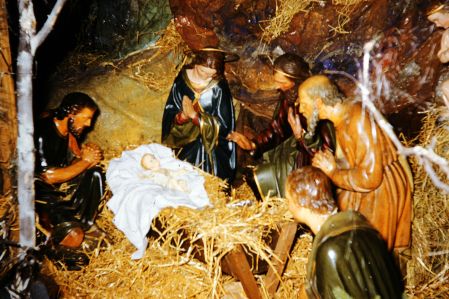
Love came down at Christmas,
Love all lovely, Love Divine;
Love was born at Christmas,
Star and Angels gave the sign.
Worship we the Godhead,
Love Incarnate, Love Divine;
Worship we our Jesus:
But wherewith for sacred sign?
Love shall be our token,
Love shall be yours and love be mine,
Love to God and all men,
Love for plea and gift and sign.
–Christina Georgina Rossetti, 1885
Posted in Christmas, Poem | Tagged Christina Georgina Rossetti, Christmas Poem |
Baby Jesus, small and soft
born that star-filled night
for ages prophets had foretold
Light to pierce the night
Your heavenly home You left behind
put eternal things aside
to enter human time and space
a temporary home.
why would You,
Almighty King
Lord of all the Lords
come down to earth to be with us
so far below Your throne
the cross it is the centerpiece
instrument of pain
see where blood was flowing down
the lamb on it was slain
O Jesus, help me see the truth
Your life was not in vain
Your coming was to meet my need
Yours a blood sacrifice
the living, it was needful
without blemish You were found
yet dying was the pinnacle
my sin stain it removed
in dying You gave your life for me
propitiatory substitute
in rising You opened eternity
rendered the accuser mute
a baby born to humble means
lain in a manger bare
is only part the story told
look further if you dare
the only true and living God
the one they call “I AM”
He kept His promise in the child
He sent His Son, the Lamb
Copyright MaryBethMullin
Posted in Christmas, Jesus, Uncategorized | Tagged Baby Jesus, Christmas Poem |
It was love, mere love; it was free love that brought the Lord Jesus Christ into our world. What, shall we not remember the birth of our Jesus? Shall we yearly celebrate the birth of our temporal king, and shall that of the King of Kings be quite forgotten? Shall that only, which ought to be had chiefly in remembrance, be quite forgotten? God forbid!
No, my dear brethren, let us celebrate and keep this festival of our church with joy in our hearts: let the birth of a Redeemer, which redeemed us from sin, from wrath, from death, from hell, be always remembered; may this Savior’s love never be forgotten! But may we sing forth all his love and glory as long as life shall last here, and through an endless eternity in the world above! May we chant forth the wonders of redeeming love and the riches of free grace, amidst angels and archangels, cherubim and seraphim, without intermission, forever and ever!
And as, my brethren, the time for keeping this festival is approaching, let us consider our duty in the true observation thereof, of the right way for the glory of God, and the good of immortal souls, to celebrate the birth of our Lord Jesus Christ; an event which ought to be had in eternal remembrance.
George Whitefield, Selected Sermons of George Whitefield

Posted in Christmas, George Whitefield, Uncategorized | Tagged Celebrating Christmas, Christmas, George Whitefield on Christmas |
Who is He? The world has struggled with this issue since Jesus came on the scene more than 2000 years ago. Was Jesus simply a man? Was he a great prophet or teacher? Or was He the Christ–the Messiah–the Promised One, fulfilling hundreds of prophecies of the Old Testament prophets?
1. What does Isaiah 7:14 foretell about Jesus (the Messiah-the Promised One)?
2. What does Isaiah 9:6-7 tell us about the Messiah?
3. What additional information is given regarding the Messiah in Isaiah 11:1?
4. What do you learn from Isaiah 53:1-3
5. When did Isaiah live and give his prophecies?
6. What does the prophet Micah tell us about the birth place of Messiah in Micah 5:2?
7. When did the prophet Micah live and give his prophecies?
8. What does the prophet Zechariah tell us about the Promised One in Zechariah 9:9?
9. When did the prophet Zechariah live and give his prophecies?
10. When read these prophecies, given hundreds of years before the person they describe was born, by three different men, and you learn that they came true in the person of Jesus, what does that make you think about the Bible? God?

Posted in Christmas | Tagged Biblical Literacy, Christmas, Christmas Bible Study, Prophecies about Christ |
Read Psalm 4
1. What does David ask of God in verse 1?
2. What 2 things does David know about God according to verse 3?
3. What instructions does David give in Psalm 4:4-5?
4. What does verse 7 teach us about God?
5. What does David tell us about his sleep in verse 8?
6. How can you apply the promises and instructions of this psalm to your own life? Give examples.

Posted in Psalms | Tagged Bible Study in Psalms, Building Biblical Literacy, Psalm 4 |
Read Psalm 3
According to the Open Bible this is “a lament, which contains elements of both petition and praise. Many of the laments end on a note of praise, signifying that the psalmist had prayed through his problem and realized god’s presence, care, and eventual resolution of the difficulty.”
1. Re-read the story of David when he fled from Absalom in 2 Samuel 15:13-17. This Psalm was written by David during this time period. What does David tell the LORD in this Psalm?
2. What is the progression of ideas in the Psalm – is David in the same place at the end as he was at the beginning? What is different?
3. How does David describe God in the psalm?
4. What did God do for David according to the Psalm?
5. In this Psalm, David expresses confidence in God – what do you think is the reason for this confidence in God on David’s part?

Posted in Psalms | Tagged Bible Study in Psalms, Biblical Literacy, Psalm 3 |
Read Psalm 2
Psalm 2 is described in the Open Bible as the first of the “royal messianic psalms.”
1. Do you see people in the world today raging against God? Why is this?
2. How do the following verses show this prophecy being fulfilled?
▸ Mark 3:6
▸ Mark 11:18
▸ Luke 19:14
▸ Acts 4:25, 26
3. Who is it referring to when it says “kiss the Son, lest He be angry?”

Posted in Psalms | Tagged Biblical Literacy, Messianic Psalms, Psalm 2 |
Read Psalm 1
Because the Psalm is short, try to read it over several times during the week. Maybe even in different translations.
1. The term “blessed” can be translated “oh so happy” or “living optimally, blissful, happy” or “oh the blessednesses! List 3 things the “blessed” or “happy” man does not do?
2. How would you explain or translate the 3 things listed above to life today? To your life? What should you not do?
3. Consider the verbs “walk,” “stand,” and “sit.” What is the difference? What is the psalmists point in using these three words in progression?
4. What do the following verses teach about those who walk in the way of wickedness or evil?
▸ Proverbs 1:15
▸ Proverbs 4:14
5. What do the following verses add about how the word will keep you from evil?
▸ Joshua 1:8
▸ Psalm 119:92, 97
6. We see in this Psalm that the Psalmist describes the blessed man like tree. What characteristics does he assign to this man?
7. What does Jeremiah 17:7-8 add to this picture?
8. What is chaff? Look it up if you are not familiar with it.
9. What do the following verses teach about God’s knowledge of the righteous man?
▸ Psalm 37:18
▸ Nahum 1:7
▸ John 10:14, 27
▸ 2 Timothy 2:19

Posted in Psalms | Tagged Biblical Literacy, Psalm 1 |
The name of the book of Psalms in Hebrew means “Praises” or “Book of Praises.” Those credited with writing the Psalms are David, 73; Moses, 1 (90th); Solomon, 2; Sons of Korah, 11; Asaph, 12, Heman, 1 (88th); Ethan, 1 (89th); Hezekiah, 10. (J. Vernon McGee, Outline of Psalms)
“The collection of 150 individual psalms is organized into five books. Psalms is not a continuous, chronologically arranged story like we find in the historical books. Unlike prophecy, Psalms has no continuing message developed chronologically or thematically. And unlike epistles (letter), Psalms has no continuous unifying teaching or train of thought throughout the book. The book is an anthology–a collection of 150 different prayers, praises, or songs.
Each psalm is a unit of expression, composed during a moment of need or desire. Each has a unique purpose, although many can be grouped in categories, like the psalms of ascents.
As you study the psalms, remember that they are poems. Hebrew poetry does not contain rhyme and meter like much English poetry. Instead, Hebrew poetry’s distinctive feature is parallelism of some form–one line relates to another in various ways. Usually the poetic lines are composed of two (sometimes three) segments in which the second segment repeats, contrasts, or completes the first. Psalms vary in design. Some are acrostics, with each verse or stanza beginning with the next letter from the Hebrew alphabet. (Praising God through Prayer and Worship, Kay Arthur, Pete DeLacy, Harvest House 2008)

Posted in Psalms | Tagged Biblical Literacy, Psalms |
 Rooted and Grounded