Feeds:
Posts
Comments

Baby Jesus Born to Die

Baby Jesus, small and soft
born that star-filled night
for ages prophets had foretold
Light to pierce the night

Your heavenly home You left behind
put eternal things aside
to enter human time and space
and temporarily abide.

why would You,
Almighty King
Lord of all the Lords
come down to earth to be with us
so far below Your throne

the cross it is the centerpiece
instrument of pain
see where blood was flowing down
the lamb on it was slain

the living, it was needful
without blemish You were found
yet dying was the pinnacle
my sins they stained the ground

in dying You gave your life for me
propitiatory substitute
in rising You opened eternity
rendered the accuser mute

a baby born to humble means
lain in a manger bare
is only part the story told
look further if you dare

the only true and living God
the one they call “I AM”
He kept His promise in the child
He sent His Son, the Lamb

Copyright M.E. Mullin Bush
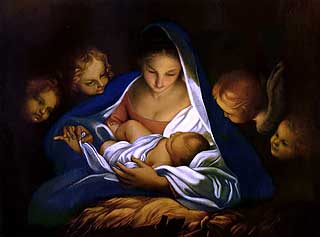
Holy_Night_Carlo_Maratta

The Trials

Read Mark 14:55-65
1. What were the Chief Priest and the counsel seeking with regard to Jesus?

2. What was the problem with the false witnesses who spoke against Jesus?

3. What do you learn from Deuteronomy 19:15 about the number of witnesses required under Mosaic law?

4. In Mark 14:60, the High Priest asked Jesus a question, record the question and Jesus’ response.

5. What was the question the High Priest asked Jesus in Mark 14:61? What was Jesus’ response?

6. What is the significance of Jesus’ reply? How did this help His accusers? How does this relate to Exodus 3:14?

7. What was the High Priest’s reaction to Jesus’ statement? Why did he react that way? What punishment did they want for Jesus? Why did they have to go to the Romans for that?

Read John 18:28-40; 19:1-16; Mark 15:1-22;
8. When Pilate asks the Jewish leaders what Jesus is accused of, how do they answer? What do you observe about that answer?

9. How does Jesus describe His kingdom?

10. In Mark 15:2, Pilate (Roman Ruler over Judea) questions Jesus as to who He is. Who does Jesus admit He is?

11. Pilate sees the motives of the Chief Priests in turning over Jesus to him. What is it? (Hint Mark 15:10)

12. What is Pilate’s verdict regarding Jesus in John 18:38?

13. Who do the people call for in John 18:40? What additional information do you learn about this “Barabbas” from Luke 23:16-25?

14. Describe the suffering of Jesus outlined in John 19:1-3 and Matthew 27:27-31.

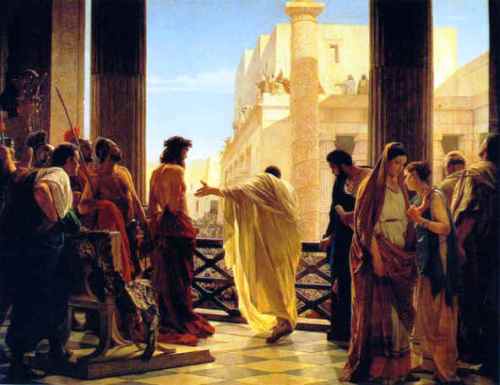
Jesus trial

The Garden

Read Mark 14:32-42
1. Where did the disciples and Jesus go after supper?

2. What did Jesus want to do? Who did he take with Him?

3. What is Jesus’ prayer in Mark 14:36? What is the “cup” to which He is referring?

4. What were John, James & Peter doing while Jesus was praying?

5. Copy Jesus’ warning to them in Mark 14:38 here. How is this a warning to us as well?

6. What does Jesus tell the disciples is happening in Mark 14:41 when He returns to them the 3rd time?

Read Luke 22:39-46
7. According to Luke 22:44, what happened to Jesus while He was praying?

8. Who comes to strengthen Jesus according to Luke 22:43?

Read John 18:1-11
9. How did Judas know where to find Jesus?

10. What happened to the troops when Jesus identified Himself?

11. What does Jesus do in John 18:8?

Read Matthew 26:14-56
12. What do you learn about the disciple Judas from Matthew 26:14-16?

13. Matthew 26:48, what was the sign Judas would use to identify Jesus?

14. How does Judas address Jesus? What does this name mean?

15. How does Jesus address Judas? Why is that important?

16. Looking back at the betrayal, what does Peter say about it in Acts 1:16-20?

17. What happened in Matthew 26:51? What is Jesus’ response?

18. What does John 18:11 record of Jesus’ statements after Peter cuts of Malchus’ ear?

19. What did the disciples do when Jesus was arrested? Why is that important? How does that compare to their conduct in Acts 2?

Redemption? Some thoughts

Some biblical concepts are easier to understand than others. Redemption may be one of the easier ones. To redeem something means to buy it back.

Imagine you are short on funds for your rent payment. The landlord is threatening to evict you if you don’t pay by the close of business. How do you get money quick? You might consider pawning your Fender guitar – not because you want to sell it, but because it has value and the pawn shop owner might give you enough cash to make your rent. When you get paid at the end of the week, you might head back to the pawn shop to redeem – or buy back – your guitar.

  • What does this have to do with Jesus?
  • Who is being redeemed?
  • From what?
  • How?

The Bible teaches us that Jesus is the redeemer. (See Galatians 3:13; Titus 2:14, Hebrews 9:12)

We are the redeemed – some of us. The redemption is not limited to any particular group of people. The redeemed come from every tribe and tongue and people and nation. Revelation 5:9)

The redemption Jesus Christ offers is redemption from the curse of the law (Galatians 3:13), from every lawless deed (Titus 2:14) and from  power of the grave (Psalm 49:15)

It is by Jesus’ own blood that He redeemed us, purchased us back from the ruler of this world (Satan). (See Hebrews 9:12, Revelations 5:9)

The best news is that this redemption Christ has accomplished for me – for you – is eternal (it has no end).

pieces of silver

Redemption?

In this series of posts on the vocabulary of the resurrection and surrounding events, today we consider redemption.

Here’s your assignment:

  1. Consider the dictionary definition of the words redeem and redemption.
  2. Consider the following verses and what they add to your understanding of redemption:
  • Psalm 49:8, 15
  • Lamentations 3:58
  • Galatians 3:13
  • Titus 2:14
  • Hebrews 9:12
  • Revelation 5:9

lamb

For this Christian (and I hope it is the same for others), words and the proper use and understanding of terms is key to the discussion of issues of faith, belief and the Bible. With that in mind, before I begin my series of studies in preparation and leading up to Resurrection Sunday, I want to look at some of the vocabulary that is central to the events and their implications for believers and non-believers.

For this post, I want to start with the word ATONEMENT.

I will share some of the insights I have in tomorrow’s post, but in preparation for that, here is your assignment:

  1. What is the dictionary definition of atonement? Consider looking in a traditional dictionary as well as a Bible dictionary. You might also consider an online resource like http://www.dictionary.com.
  2. Consider Leviticus 17:11. What does it add to your understanding?

nothing but the blood

As promised, here’s some of what I found and thought on the issue of atonement:

Paul E. Little in Know What You Believe says “atonement means, “at-one-ment”–that is to say, a bringing together of those who are estranged.” He concedes that in the Old Testament, atonement referred more to a covering. The covering for sin provided under the sacrificial system would suffice until the death of Christ. In the New Testament, Little says that atonement encompasses several ideas, namely reconciliation (as mentioned in Romans 5:10), and appeasement or propitiation–“the removal of wrath by the offering of a gift.” (See Romans 3:25).

According to Grudem in his Systematic Theology, two aspects of the character of God are at work in the atonement: His love and His justice. The love we see explained in John 3:16 and the justice we find in verses such as Romans 3:25. Grudem says, “the love and the justice of God were the ultimate cause of the atonement. . . . without the love of God, he would never have taken any steps to redeem us, yet without the justice of God, the specific requirement that Christ should earn our salvation by dying for our sins would not have been met. Both the love and the justice of God were equally important.”

For me, atonement brings to mind imagery of the Old Testament, blood filling the Kidron Valley at Passover and other high holidays as it flowed from the Temple, from the sacrifices killed one after the other on the bronze altar in the court yard–the blood flowed out of the animal and met the sin of the offeror. God had established the blood as a means to cover the offeror’s sin. It was His law.

So it was with Jesus, with His blood on the cross. His blood met my sin–it satisfied the debt my sin represented in the economy of God. It was a permanent solution to my sin problem.


Perhaps a hymn by William Cowper can best express the idea:

There is a fountain filled with blood 
Drawn from Immanuel’s veins,
And sinners plunged beneath that flood
Lose all their guilty stains

Read Genesis 10
1. What nations were descended from Noah?

2. What are the modern day nations occupying these lands?

3. Which son of Noah is the going to be the line through which God redeems His people? How do you know?

4. What lessons did you learn from the life of Noah?

5. What did you learn about God from the life of Noah?

ham shem japh


GENESIS 9 – Noah (Part 4)

Read Genesis 9
1. What command does God give Noah and his family in Genesis 9:1?

2. What command does He give them in Genesis 9:4-6?

3. In Genesis chapter 9, God establishes a covenant with Noah. Answer the following questions regarding the covenant from the text:

  • With whom does God make the covenant?
  • What is the covenant He is establishing?
  • What is the sign He gives for the covenant?

4. Who are the sons of Noah?

5. What happens to Noah in the end of Chapter 9?

6. What do you learn from these events about Noah? About Noah’s sons? About God?

7. How long did Noah live after the flood? Altogether?

shem-ham-japheth

GENESIS 8 – Noah (Part 3)

Read Genesis 8
1. Copy Genesis 8:1 here.

2. Where did the ark come to rest? How long did it rest there before the tops of the mountains were seen?

3. When did Noah remove the covering from the ark?

4. What did Noah do before removing the covering to make sure it was safe?

5. When did God tell Noah they could leave the ark?

6. What was the first thing Noah did after leaving the ark?

7. What promise does God make in Genesis 8:21-22?

DSC_1344.JPG